CO₂ balance? Let’s just start.
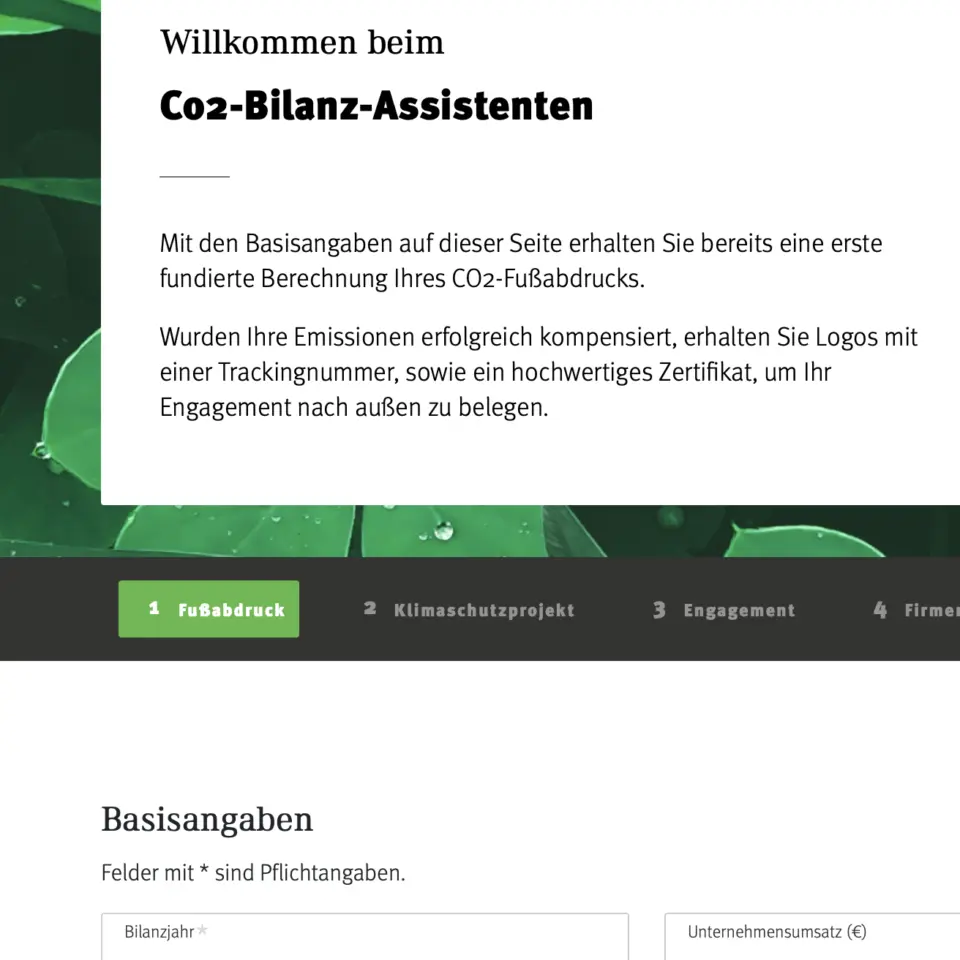
With our BASIC tool, you get clarity about your emissions – in minutes, not months.
Ideal for service companies with up to 500 employees.

The Carbon Footprint identifies your company’s sources of emissions – even in areas not immediately obvious in day-to-day operations.
Many companies need CO₂ figures today because customers ask for them, supply chains require them, or they are mandatory in tenders.
A Corporate Carbon Footprint ensures that you can provide reliable information – both internally and externally.
With a CCF, all relevant information is clearly available – properly calculated, ready to use and without time-consuming data hunting.
It shows which areas truly matter and where actions will make sense later on. This lets you set priorities without guessing: What pays off? What doesn’t? What can wait? For both small and large companies, a CCF provides a dependable foundation – clear, practical and without unnecessary complexity.
We follow a clear process that respects your time while delivering technically precise results.
1. Data review and definition of system boundaries
Together, we assess what characterises your company. We collect consumption data related to energy, vehicle fleets, buildings and operational processes. We start with the data already available in your accounting or technical systems and close data gaps only where this is truly necessary to ensure a robust CO₂ footprint.
2. Structuring in line with the GHG Protocol (Scopes 1, 2 and 3)
We assign your data to the internationally recognised categories: direct emissions from owned or controlled sources (Scope 1), indirect emissions from purchased energy (Scope 2), and emissions from upstream and downstream value chains (Scope 3). This creates transparency around which parts of your operations contribute which share of your overall footprint.
3. Calculation based on ISO 14064 and scientific standards
Using recognised databases (such as ecoinvent), we calculate your company’s greenhouse gas emissions. The methodological framework is based on ISO 14064 and the GHG Protocol. All figures remain fully verifiable for auditors, and every calculation step is comprehensively documented.
4. Delivery of an audit-ready corporate footprint
You receive a technically sound results report, which we explain to you clearly and in detail. The footprint can be used immediately – for responding to customer inquiries, participating in public tenders, or as a solid factual basis for internal planning and reduction measures.
At the end of the process, you will have a carbon footprint that clearly illustrates where emissions arise and how the data is structured. Transparent, thoroughly documented, and without unnecessary complexity.
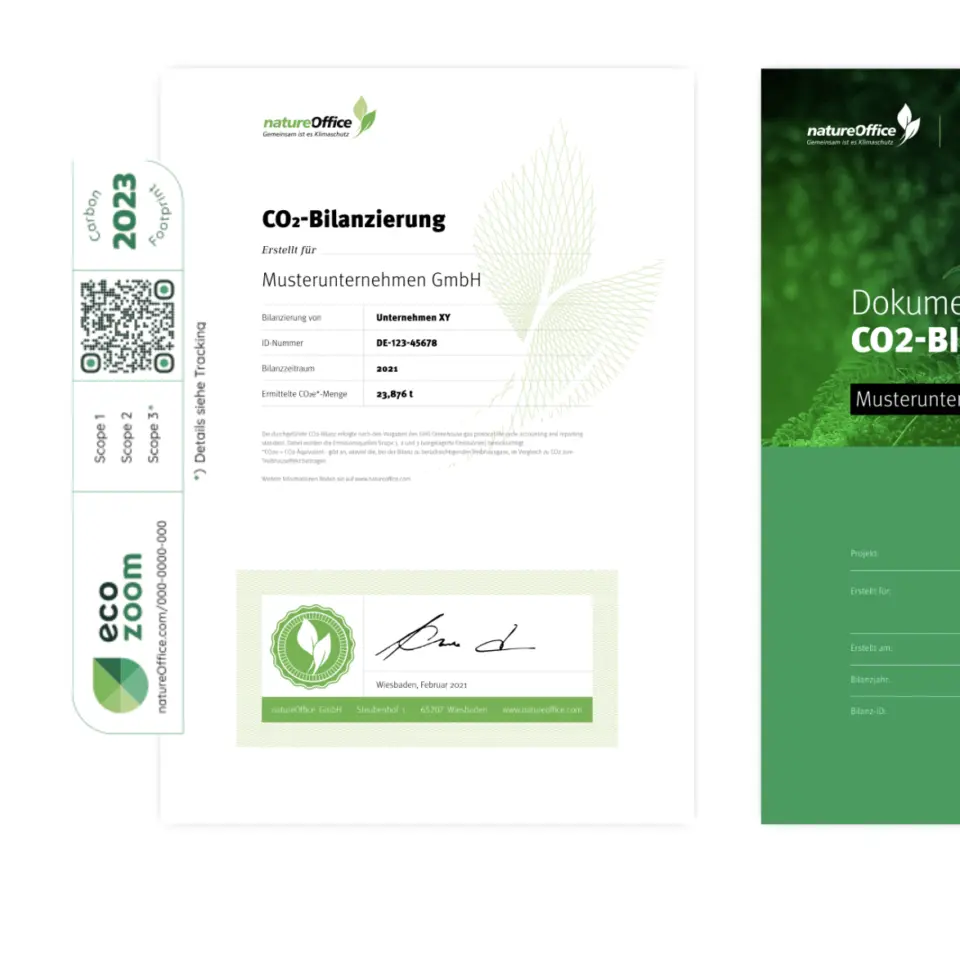
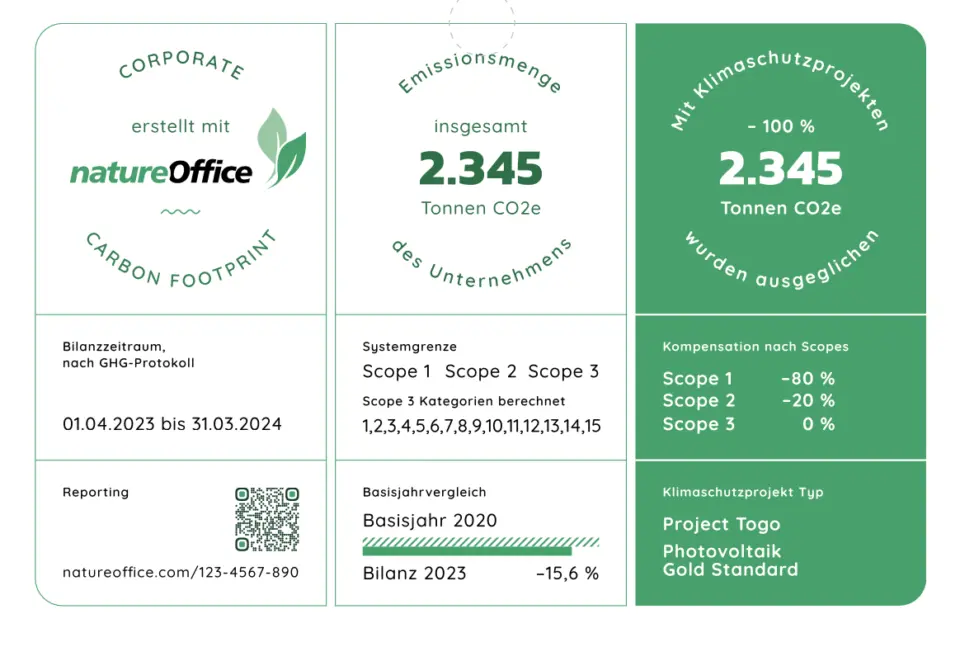
Your Corporate Carbon Footprint precisely identifies your company’s emissions – categorized by location, department, and Scopes 1, 2, and 3. You receive a structured overview based on the GHG Protocol, ready for immediate use in your internal and external documentation without further processing.

All assumptions, used emission factors, and data points are fully documented. This ensures your CCF is ISO 14064 compliant and prepared at any time for audits by certified accountants, inquiries from business partners, or internal reviews. You can explain exactly how your values were calculated.

In many industries, carbon metrics are now a prerequisite for bids and inclusion in supplier portals. With a completed CCF, these values are available for immediate distribution to customers – professionally substantiated and without any additional internal effort.
You can see exactly which business areas generate the highest consumption. The CCF provides the necessary foundation for planning realistic reduction measures and prioritizing actions in procurement or logistics – based on facts rather than assumptions.
We’ll listen, help you sort out your starting point and clarify what really matters for you.

Questions? Answers!
Madhav Joshi
Specialist Environmental Analysis & Consulting
We are here to help you as quickly as possible
Available by phone Mon–Thu 9 a.m.–5 p.m. | Fri 9 a.m.–3 p.m.
Answers to the questions that most often come up when creating a company-wide CO₂ footprint.
A CCF is often needed for tenders, customer meetings, supply-chain requirements and internal decision-making.
Many companies need concrete CO₂ figures to submit offers, attach certificates or meet supplier requirements.
A CCF ensures that these figures are always available and easy to explain.
Yes. The CCF is the appropriate and accepted basis when it comes to a company’s emissions.
It meets common requirements from tenders, ESG questionnaires, supply-chain checks or customer requests – provided it is GHG-compliant and transparently documented.
No, not all. For many companies, it is enough to include the relevant Scope 3 categories.
What matters is which areas have a noticeable share of emissions or are expected externally.
We prioritise together which data is truly necessary.
A good CCF is traceable, verifiable and usable.
It does not only show total emissions, but breaks them down by areas and scopes. A single number without documentation has little value – a structured CCF, however, can be shared, explained and used for decisions.
Any company that:
is part of supply chains,
submits tenders,
must provide CO₂ figures to customers,
or needs a first structured overview to support internal decisions.
Many SMEs quickly realise how frequently reliable CO₂ figures are requested today.
It needs to be detailed enough to be traceable and withstand external requests – but not more complex than necessary. A good CCF captures the relevant emission sources and uses factors that are clearly documented. Overly complex models add no value.
That’s normal. Missing values can be supplemented with factors, estimates or averages – always transparently, so it’s clear later how the numbers were derived.
The goal isn’t perfection – it’s traceability.
At least once a year, especially if tenders, customer projects or internal steering rely on it.
Many companies update their CCF after the financial year or ahead of key reporting deadlines.
Yes, if it was created in line with GHG standards and properly documented. Most reporting systems accept a CCF as the basis for Scope 1, Scope 2 and major parts of Scope 3 data.
When customers or tenders request product-specific CO₂ figures.
The CCF answers “How much does the company emit?”.
The PCF answers “How much does this product emit?”.
Both complement each other but are used for different purposes.
The investment depends on how much of the work you want to do yourself. We offer maximum transparency:
Solution A: Software (Do-it-Yourself) With our BASIC tool, you collect your data independently with guided support. Cost: From €600 (plus VAT) per footprint/year. Ideal for: SMEs looking for a cost-efficient start.
Solution B: Full-Service (Guided Creation) Our experts handle data collection, plausibility checks, and report generation for you. Project packages for small to medium-sized companies usually start from approx. €2,500 (plus VAT). Ideal for: Companies with limited time or those requiring absolute audit security.
This depends primarily on your data availability.
Fast: If you have your consumption data (electricity, heating, fleet) at hand, our software delivers results in just a few hours.
Thorough: A guided consulting project usually takes 2 to 4 weeks if you are well-prepared and all data is available. We help you close data gaps and keep the effort on your end to a minimum.
Large companies are directly affected by the reporting obligation (CSRD) starting in 2025. But be careful: Many SMEs are indirectly affected because banks and major clients request this data as part of the supply chain. A compliant CCF is your "insurance" to stay competitive in tenders and ratings.
That depends on your goal:
Software (nature.io): Ideal if you want fast, cost-effective, and independent results – e.g., for an initial baseline assessment.
Consulting: Recommended if you have complex structures, need absolute security for audits, or want to develop a deeper reduction strategy.
The Corporate Carbon Footprint (CCF) is far more than just a list of emissions—it is the fundamental management tool for your sustainability strategy. At natureOffice, we calculate your company’s footprint strictly according to the GHG Protocol (Greenhouse Gas Protocol) and ensure audit-readiness for external auditors. We systematically record your direct emissions (Scope 1), indirect emissions from purchased energy (Scope 2), as well as the critical upstream and downstream activities within your supply chain (Scope 3).
This sound greenhouse gas inventory is the mandatory prerequisite for compliant reporting according to CSRD and ESRS E1 standards. Our analysis serves as an objective baseline for defining science-based targets (SBTi-aligned) and developing a realistic decarbonization roadmap. With a CCF from natureOffice, you create full transparency for banks, investors, and customers, laying the foundation for future-proof carbon management on the path toward your Net-Zero goals.