
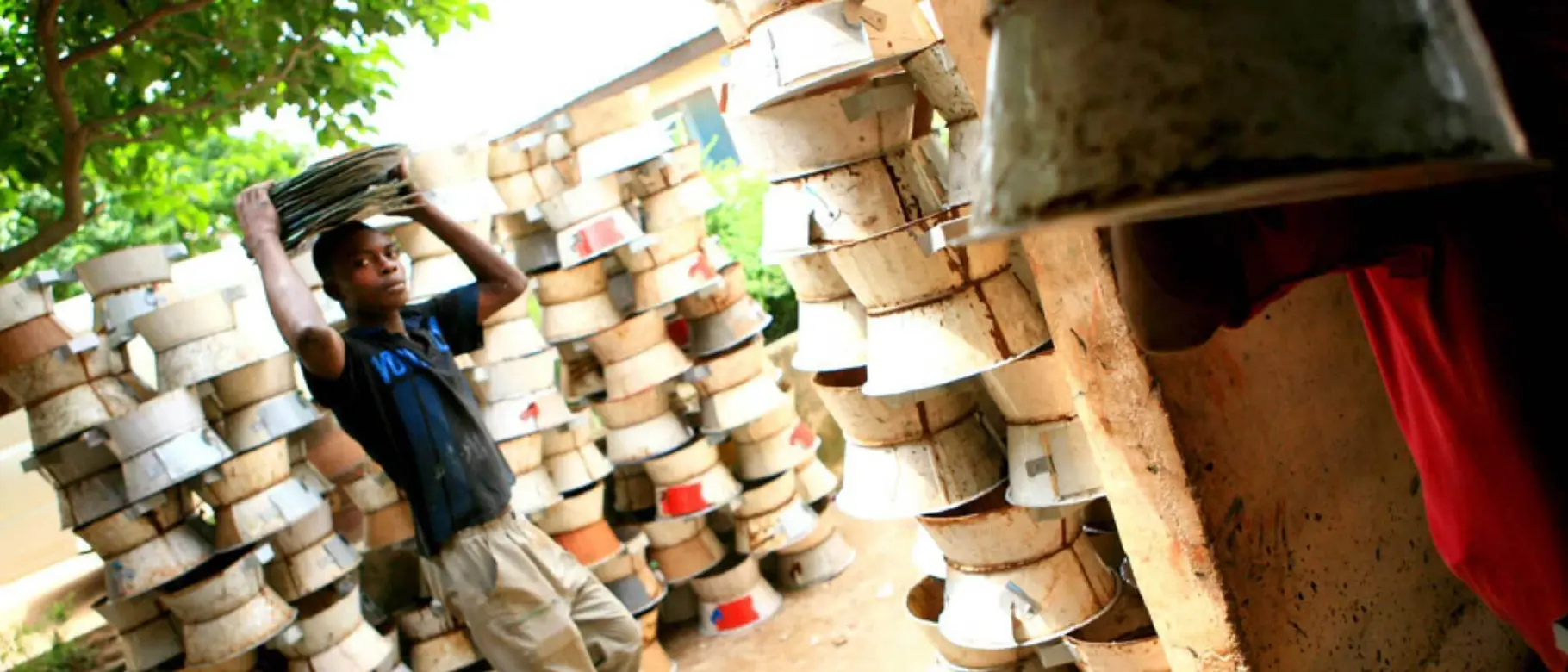
Less charcoal, less smoke – better health
Promoting Improved Cooking Practices, Nigeria
In Nigeria, improved cookstoves are replacing traditional cooking setups using wood or charcoal—often open fires or very inefficient stoves.
These improved stoves use significantly less fuel. That reduces smoke in the kitchen, cuts emissions, and eases household budgets. Over the stoves’ lifetime, this delivers measurable greenhouse-gas reductions year after year.
A project that shows: technology doesn’t have to be complicated to create impact—if it works in everyday life and is properly documented.
Technical project data – (GS7312)
The key facts of the cookstove project at a glance.
| Parameter | Description | Source |
|---|---|---|
| Project location | Nigeria, all regions; geographic reference (country): 9° 4' 55.196" N, 8° 40' 30.997" E | PDD, Section A.2 (Location of project) / Monitoring Report, Section A.2 |
| Project type | Roll-out of high-efficiency Toyola cookstoves to replace inefficient cookstoves / open fires | Monitoring Report, Section A.1 (General description of project) |
| Project standard | Gold Standard for the Global Goals (GS4GG) | PDD, Cover / Key Project Information (GS4GG) |
| Methodology | Technologies and Practices to Displace Decentralized Thermal Energy Consumption, Version 3.1 | Monitoring Report, Section A.3 |
| Project start | Project activity under GS context from the start of the crediting period (see Crediting Period) | Monitoring Report, Section A.4 |
| Crediting Period | 1st crediting period: 24.10.2017 – 23.10.2022, 5 years, renewable twice | Monitoring Report, Section A.4 |
| Project status | Certified Gold Standard project (actively reported in monitoring) | PDD (Key Project Information) + Monitoring Report |
| Type of technology | Non-electric cookstoves (household & commercial), multiple sizes – same core technology, treated as a homogeneous project population | Monitoring Report, Section B.1 |
| Number of stove models | 5 model sizes: Household Small/Medium/Large (HS/HM/HL) + Community/Commercial Small/Large (CS/CL) | PDD, Section A.3 (Technologies/measures) |
| Fuel type | Charcoal | Monitoring Report, Section B.1 |
| Thermal efficiency | Project stove: avg. 34.87% (from WBT results; model-specific values in the PDD) | PDD, monitoring/methodology part (note: “Project stove thermal efficiency … 34.87% from WBT results”) |
| Maximum stove lifetime | Technical lifetime: 10 years (manufacturer statement) | PDD, technical/stove specification (directly after the efficiency table) |
| Cookstoves distributed (total) | 494,837 stoves sold/distributed up to 31.12.2022 | Monitoring Report, Section A.2 (Sales Summary) |
| Cookstoves in the current monitoring period | 426,495 stoves eligible for crediting (after correction factor for multiple stoves per household) | Monitoring Report, Section A.2 (Eligibility / correction factor) |
| Main impact mechanism | Less charcoal due to higher efficiency; emission reduction includes factors such as non-renewable biomass fraction (fNRB: 93%) and reduced fuel demand | Monitoring Report, data/parameter section (fNRB value) |
| Monitoring & verification | Monitoring includes regular surveys (usage/adoption), conservative assumptions & documentation; independent review as part of GS verification | PDD, monitoring description (annual surveys) + Monitoring Report |
| Carbon credit rating | No external project-specific rating currently indicated | Project documentation (PDD/MR): no rating stated |
| Carbon credit rating type | No external rating methodology applied/indicated | Project documentation (PDD/MR): no rating stated |
| Article 6 authorization (Paris Agreement) | No authorization indicated | Project documentation (PDD/MR): no Article 6 statement |
| CCP status (ICVCM) | No CCP classification indicated | Project documentation (PDD/MR): no CCP statement |
| Approach to double counting risks | Gold Standard rules; plus: carbon-rights waiver in end-customer documentation (transfer of carbon credit rights to the project entity) | PDD, Section A.2 (Carbon Credit Rights / waiver in sales record) |
| Additionality | Additionality/financial need demonstrated under GS4GG rules (deemed additional / financial need per GS requirements) | PDD, Section B.5 (Demonstration of additionality) |
| Long-term nature of emission reductions | Impact over multi-year stove use (lifetime + adoption/usage monitoring) | PDD (10-year lifetime + monitoring approach) |
| Permanence of climate impact | Usage-dependent emission avoidance (no physical permanence like removal/sink projects) | Project type interpretation (cookstove methodology / GS logic) |
| Risk management & safeguards | Correction factors (e.g., multiple stoves per household), conservative delimitation of the monitoring period, ongoing monitoring of use | Monitoring Report, Section A.2 (correction factor) + monitoring section |
| Social & environmental safeguards | Gold Standard Safeguarding Principles + project-specific assessment (incl. gender aspects) | PDD, Section D (Safeguarding/Gender) |
What the project can contribute
Here we summarize what the project is actually intended to achieve and which practical improvements it can enable.
- 1
Efficient cooking instead of outdated cooking setups
In Nigeria, the project replaces traditional, inefficient cooking setups with improved cookstoves. Because less fuel is needed per meal, emissions from combustion decrease in a measurable way. This creates climate impact in a sector that is huge in daily life—yet often overlooked.
- 2
Easing the burden on households – time, money, effort
When fuel demand goes down, ongoing costs typically go down as well. At the same time, less effort is needed for purchasing, transporting, and storing fuel. For many families this is not a “nice-to-have,” but a tangible, everyday relief.
- 3
Less pressure on wood and charcoal resources
Lower consumption means lower demand. That can reduce pressure on local biomass resources—especially where charcoal and wood are scarce, expensive, or require longer collection routes. Climate action here is also resource protection.
- 4
Strengthening local structures – a market, not a one-off
The project relies on roll-out through local production/distribution and quality assurance. This is more than a one-time delivery of stoves—it helps build a more stable market for efficient cooking technologies, including jobs, know-how, and service structures.
- 5
Less indoor smoke – less exposure
More efficient combustion usually also means less smoke and soot in the kitchen. That improves indoor air quality and reduces health risks, especially for people who spend a lot of time at the stove—often women and children. At the same time, local environmental pollution decreases.
Request information now
Global climate relevance
Emission reductions
Efficient cookstoves are a direct lever for measurable emission reductions in the household sector. In Nigeria, the climate impact mainly comes from burning less fuel per cooking event—resulting in less CO₂e. Savings are made transparent through monitoring and verification and reflected in carbon credits.

Less fuel – less pressure on resources
The core mechanism is simple: lower consumption. When households need significantly less charcoal for the same meal, demand for non-renewable biomass falls. This affects emissions—but also eases local fuel supply chains, particularly where charcoal is scarce or costly.

Cleaner combustion, less smoke
Improved stoves operate more efficiently than traditional cooking setups. This typically leads to cleaner combustion—with less smoke and pollutants indoors. At the same time, emissions linked to inefficient charcoal combustion decrease. Climate impact and local environmental benefits go hand in hand here.

Additionality
Building widespread production, distribution, and quality assurance for efficient cookstoves does not happen “by itself.” Carbon market revenues are a key financing driver: they enable scale, standards, and monitoring—i.e., the conditions needed for measurable, lasting impact. Without this climate finance, such programs are typically smaller, slower, or economically unviable.
Sustainable Development Goals (SDGs) – The relevant and the complementary contributions
Beyond its CO₂ impact, the Nigeria cookstove project typically delivers additional household benefits: less fuel demand, cleaner cooking, and everyday relief—plus (depending on implementation) effects on local distribution/production structures. The strongest, most directly attributable contributions are to SDG 7 and SDG 13. Other SDGs are supported secondarily or are more indirect (as they depend strongly on local context).
The project brings more efficient cooking technology to households and small businesses. This improves energy use for cooking—requiring less fuel per meal.
Contribution: More efficient everyday energy use and reduced fuel consumption (e.g., charcoal).Using less fuel means fewer emissions from combustion. Savings are captured through monitoring and reported as CO₂ reductions.
Contribution: Measurable greenhouse-gas reductions through more efficient cooking practices.Cookstove programmes like this typically build local sales and service networks and may include local production/assembly. This can strengthen incomes and jobs across distribution and maintenance structures.
Contribution: Local value creation through sales, distribution, maintenance and training.Lower fuel demand leads to more resource-efficient household energy use—not as “doing without,” but as a clear efficiency gain.
Contribution: More resource-efficient use of biomass/fuels in the household sector.More efficient combustion can reduce indoor smoke exposure, improving cooking conditions and potentially reducing health risks.
Contribution: Indirect health benefits through less smoke/particulate matter indoorsIf demand for fuel decreases, pressure on forest and biomass resources may be reduced. This is a supportive effect, not a direct conservation mechanism.
Contribution: Potentially reduced pressure on wood resources due to lower fuel demand.
How CO₂ savings are generated
Clean cookstoves use significantly less fuel than traditional open fires. As a result, less wood, charcoal or other biomass is burned — and this directly reduces CO₂ emissions.
The amount of fuel saved can be measured and forms the basis for CO₂ certificates.
Traditional cooking methods are often inefficient and require large quantities of wood or charcoal. Efficient stoves use heat more effectively, burn more cleanly and reduce cooking time. Every unit of fuel saved results in fewer emissions from combustion.
Depending on the region and the type of fuel used, there are clearly defined emission factors that indicate how much CO₂ is released per kilogram of wood or charcoal.
For each project, calculations determine how much fuel would have been used without the clean stove (the baseline) and how much is actually needed. The difference shows how many emissions have been avoided. These values are verified and regularly updated — and this is what CO₂ certificates are based on.
Context and transparency
This cookstove project is registered under the Gold Standard for the Global Goals and is regularly monitored and verified. The reported emission reductions are based on audited monitoring reports and recognised methodologies for calculating greenhouse gas reductions in the household sector.
The project stands as an example of climate action measures in the household sector that are measurable, transparent, and designed for long-term impact.