
Stopping landfill methane – and turning it into electricity
Landfill Gas Extraction and Electricity Generation Project, Istanbul, Turkey
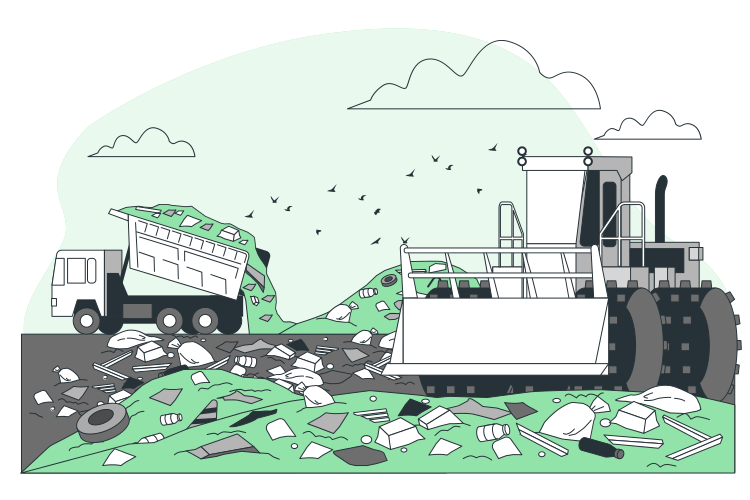
In Istanbul (Turkey), the landfill gas project at the Kömürcüoda and Odayeri sites captures methane from waste disposal that would otherwise escape uncontrolled into the atmosphere.
By capturing landfill gas, the project prevents methane from waste decomposition from venting uncontrolled. The gas is collected via wells and a pipe network, measured at collection points (including volume and methane content), and then utilized: most of it is combusted in gas engines to generate electricity, while surplus gas is safely oxidized in an enclosed flare. This significantly reduces highly climate-damaging methane emissions while also producing electricity that is fed into the grid.
The climate impact is designed as a permanently operated infrastructure measure. Key parameters (gas flows, gas quality, electricity generation) are systematically monitored and form the basis for emissions calculations. This makes it transparently traceable how much methane is destroyed and how much electricity is generated—an approach built for continuous operation with a clear, verifiable impact logic in the waste and energy sectors.
Technical project data – GS707
The key facts about the landfill gas project at a glance.
| Parameter | Description | Source |
|---|---|---|
| Project location | Turkey; Istanbul; two landfill sites: Kömürcüoda (Asian side, Şile County) and Odayeri (European side, Eyüp County) | PDD (v26, 05 Dec 2017), Section A.2.4 |
| Project type | Landfill gas (LFG) capture and electricity generation; surplus gas is flared | PDD (v26, 05 Dec 2017), Section A.1 |
| Project standard | Gold Standard for the Global Goals; Project ID GS707 | Monitoring Report (v05, 31 Dec 2024), Key Project Information |
| Project participant / operator | Yeşil Global Enerji A.Ş. (formerly Ortadoğu Enerji) | Monitoring Report (v05, 31 Dec 2024), Section A (Description of project) |
| Technology / approach | Gas wells + pipe network; measurement at manifolds (e.g., gas volume/composition/LHV); gas engines + generators for electricity; flare system for surplus gas | PDD (v26, 05 Dec 2017), Section A.3 (Technologies and/or measures) |
| Installed units (engines) | 38 gas engines (Odayeri 24, Kömürcüoda 14) | Monitoring Report (v05, 31 Dec 2024), Section A (Description of project) |
| Installed capacity | Odayeri 33.807 MW, Kömürcüoda 16.980 MW (installed capacity) | Monitoring Report (v05, 31 Dec 2024), Section A (Description of project) |
| Start of electricity generation | Odayeri 30 Dec 2008; Kömürcüoda 16 Jul 2009 | Monitoring Report (v05, 31 Dec 2024), Section A (Description of project) |
| Baseline scenario | Waste is disposed and decomposes; no capture/destruction of landfill gas; methane escapes (landfill gas typically ~50% methane) | PDD (v26, 05 Dec 2017), Section A.1 |
| Methodology | ACM0001: Flaring or Use(d) of Landfill Gas, Version 18.1 | Monitoring Report (v05, 31 Dec 2024), Key Project Information |
| Crediting period (type / length) | Renewable crediting period, 7 years | PDD (v26, 05 Dec 2017), Section C.2.1–C.2.3 |
| Crediting period start dates | Start 1st CP: 21 Aug 2010; Start 2nd CP: 20 Nov 2017 | PDD (v26, 05 Dec 2017), Section C.2.2 |
| Monitoring & verification | Regular monitoring; independent verification incl. desk review and on-site visit (29 Nov 2024) | Verification Report (v02, 20 Jan 2024), Certification statement / Verification methodology and process |
| Project lifetime / long-term nature | Expected lifetime: 23 years (term of the electricity generation licence) | PDD (v26, 05 Dec 2017), Section C.1.2 |
| Additionality | Additionality is substantiated via barriers/investment context and the role of carbon revenues | PDD, Section B.5 “Demonstration of additionality” |
| Permanence & risk management | Technical emission avoidance (methane destruction) over the operating period; “permanence” as in forestry is not applicable—key is continuous operation, monitoring and verification | Monitoring Report (PO), QA/QC & Data storage |
| Handling of double-counting risks | Emission reductions are managed through the Gold Standard registration process (GS registration reference in the verification report) | Verification Report (2nd MP), GS Registration Reference No. 707 |
| Article 6 authorisation (Paris Agreement) | No Article 6 authorisation indicated | – |
| CCP status (ICVCM) | No CCP classification published | – |
| Carbon credit rating (external, e.g., BeZero/Sylvera) | No project-specific external rating published | – |
| Contribution to national climate strategy | Contribution to emission reductions in Turkey through methane avoidance in the waste sector and electricity supply to the national grid; also supports modern waste management and reduced dependence on imported energy | PDD (v26, 05 Dec 2017), section “Contributions to Sustainable Development” |
What the project can contribute
Here we summarise what the project in Istanbul achieves in practice—and why it matters for the climate.
- 1
Significantly reduce methane emissions from landfills
Landfills generate gas with a high methane share. The project captures this gas via wells and pipelines instead of letting it escape uncontrolled.
- 2
Ensure climate impact through controlled combustion
Captured landfill gas is primarily used in gas engines; surplus gas is combusted in an enclosed flare. This reliably destroys methane and creates climate impact “at the source”.
- 3
Feed electricity from waste gas into the grid
The engines drive generators and the electricity is supplied to Turkey’s grid. This can displace conventional power generation as an additional benefit alongside methane avoidance.
- 4
Embed modern landfill technology in ongoing operations
The project combines infrastructure and operational routines: gas capture, condensate management, measurement and control systems, and clear operating processes across two large landfill sites. This matters because the impact depends on continuous operation—not a one-off installation.
- 5
Secure measurability and traceability over time
Climate impact is documented through monitoring data (e.g., gas parameters, electricity volumes, operational status of engines/flare) and is regularly verified under the Gold Standard process.
Request further information
Global climate relevance
Rapidly effective methane mitigation
Methane has a strong short-term climate effect. Projects that technically prevent methane emissions from landfills address a lever with immediate climate relevance.

Climate action in a growing metropolitan area
Istanbul is a very large city with substantial waste volumes. Systematic capture and destruction of landfill gas has impact where emissions would otherwise very likely occur.

Dual mechanism: emission avoidance plus grid electricity
The climate impact is driven primarily by methane destruction and additionally by electricity generation that can displace grid power. This makes the impact more robust because it does not rely on a single factor.

Long-term impact through continuous operation and oversight
Landfills emit over many years. A permanently operated capture and combustion system, combined with monitoring and verification, provides the conditions for long-term, secured emission reductions.
Sustainable Development Goals (SDGs) – The relevant and the complementary contributions
In addition to avoiding greenhouse gas emissions, the project strengthens controlled landfill gas management in Istanbul and uses the gas for energy generation. This reduces emissions where they typically occur over long periods in a growing metropolitan area: in the waste sector and the power system. The core contribution is to SDG 13 (Climate Action). SDG 7 (Affordable and Clean Energy) is a logical complementary contribution because electricity from captured landfill gas is fed into the grid. Other SDGs are supported indirectly; some should be considered secondary or marginal contributions.
The project prevents landfill methane from escaping uncontrolled into the atmosphere. The gas is captured and combusted in a controlled way—primarily in engines for electricity generation, with surplus gas treated via flaring. This creates climate impact directly by avoiding highly climate-damaging methane emissions.
Contribution:
The project prevents methane from the landfill from being released uncontrolled into the atmosphere. The gas is captured and combusted in a controlled manner (in engines or via flaring), measurably reducing particularly harmful emissions.Captured landfill gas is used as an energy source: the facility generates electricity and feeds it into the grid. This provides additional power generation that can partially replace conventional electricity production.
Contribution:
The project uses captured landfill gas to generate electricity and supplies the power to the national grid. This unlocks an additional energy source and—depending on the grid mix—can partially displace conventional electricity generation.In a large city, waste management is a key element of public infrastructure. Capturing and treating landfill gas in a controlled way reduces emissions from municipal waste disposal and indirectly supports more robust, modern urban infrastructure.
Contribution:
In a metropolis like Istanbul, controlled waste treatment is a core infrastructure component. Systematic capture and treatment of landfill gas reduces emissions from the city’s waste sector and indirectly supports a more robust, modern urban infrastructure.The project addresses a consequence of consumption—waste volumes—with a measure that reduces emissions from disposal and uses landfill gas for energy. In this way, part of the “downstream” emissions from waste is treated systematically.
Contribution:
The project targets emissions that arise from waste disposal as a consequence of waste generation. By capturing, using and combusting landfill gas in a controlled manner, these “downstream” emissions are systematically reduced rather than released uncontrolled.Technical infrastructure (gas capture, measurement and control systems, engines/generators, flare) as well as operating and monitoring routines are essential for creating sustained impact. This is an infrastructure contribution, but not the project’s core purpose.
Contribution:
Delivering impact requires reliable technology and long-term operating processes: gas capture, measurement and control systems, power generation, flare operation and monitoring routines. The project therefore establishes technical and organisational infrastructure that makes long-term emission reductions practically achievable.
How CO₂ savings are generated
When organic waste decomposes in landfills, it produces landfill gas with a high methane content. Without capture, this methane would largely escape uncontrolled and substantially increase climate impact.
This is why the project works as follows: landfill gas—largely methane—is produced over many years. Methane is a particularly potent greenhouse gas. Without measures, it would escape uncontrolled.
The project collects landfill gas via gas wells and pipelines and measures at defined points how much gas is generated and what the methane share is. The gas is then combusted in a controlled way: primarily in gas engines for electricity generation, with surplus gas treated in a flare. Combustion converts methane into CO₂—the climate benefit comes mainly from preventing methane from being released as methane into the atmosphere. The electricity produced is also fed into the grid and can partially replace conventional electricity generation.
To generate CO₂ credits, the avoided emissions are calculated from monitoring data (gas volumes, methane content, operating data) using an approved methodology (ACM0001). These calculations and the underlying data are then independently verified. Only on this verified basis are the emission reductions issued as certificates.
Context and transparency
The Istanbul Landfill Gas Extraction and Electricity Generation Project (GS707) is registered under the Gold Standard and is subject to regular monitoring as well as independent verifications by accredited auditors. The reported emission reductions are based on documented monitoring data (including captured gas volumes and electricity generation) and are calculated using the recognised ACM0001 methodology. Based on the reviewed monitoring and verification reports, the emission reductions are then issued as certificates.
Carbon offsetting with substance: legal robustness and clean climate communication
Carbon offsetting is under significantly closer scrutiny today—due to stricter requirements for environmental claims and a more critical public debate. Anyone communicating with terms such as “CO₂-compensated”, “carbon neutral” or “climate neutral” needs a robust foundation: a sound carbon footprint and transparent documentation of what was offset—and how the climate impact is achieved.
A legally robust approach therefore starts with the data base. We calculate your Corporate Carbon Footprint (CCF) and—where products are involved—your Product Carbon Footprint (PCF) in line with international standards. This provides the foundation for sustainability reporting (e.g., under VSME) and for communication based on verifiable facts rather than assertions.
For offsetting itself, the key is evidencing quality: clear methodologies, monitoring, independent verification and transparent registry processes. Technological climate projects—such as those in the waste and energy sectors—offer a particularly measurable impact logic, because emissions are technically prevented or reduced in a controlled way.
This is how compensation becomes a clearly framed component of carbon management rather than a PR topic—supported by a clean claim logic for website, proposals and reporting.