
Wind power from the Red Sea region – Ras Ghareb
Ras Ghareb Wind Energy Project, Egypt
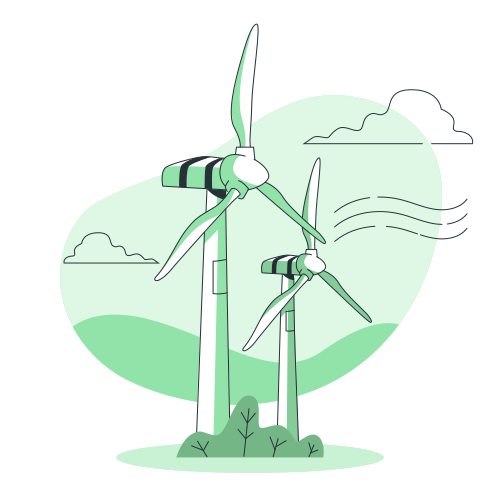
The Ras Ghareb Wind Energy Project is located in Egypt’s Red Sea Governorate, around 20 km west of Ras Ghareb on the Gulf of Suez. It is a grid-connected wind farm with an installed capacity of 262.5 MW (125 wind turbines) and feeds the generated electricity into Egypt’s power grid; the electricity is supplied to the state-owned grid company EETC.
By feeding wind electricity into the grid, electricity from the existing grid mix can be displaced on a calculated basis—electricity that, without the project, would still be supplied in part by conventional, emissions-intensive power plants. That is exactly where the climate impact occurs: within the power system—because the actual amount of electricity delivered to the grid is measured and documented, allowing the avoided emissions to be quantified in a transparent and traceable way (methodology ACM0002).
A project that shows how large-scale wind power can contribute to a more climate-friendly electricity supply over the long term—as operating infrastructure, with a clear displacement logic and measurable impact based on grid delivery.
Technical project data – GS 11557
Key facts about the wind power project at a glance.
| Parameter | Description | Source |
|---|---|---|
| Project location | Egypt; Red Sea Governorate; approx. 20 km west of Ras Ghareb (Gulf of Suez); project boundary & coordinates documented. | TRF, Section A.2–A.3; MR, coordinates/turbine overview |
| Project type | Grid-connected onshore wind power project (Sectoral Scope 01 – Energy Industries). | MR, project/key information; PDD, Section A.1 |
| Project standard | Gold Standard for the Global Goals (GS4GG) (Gold Standard). | MR, header/key information; FVR/Verification Report, header |
| Additional standard | No additional standard stated in the available documentation. | Project documentation |
| Project developer | Project Developer/Proponent: Ras Ghareb Wind Energy S.A.E. (RGWE); electricity sale/grid delivery to Egyptian Electricity Transmission Company (EETC). | MR, Section A.1; PDD, Section A.1; TRF, ownership/PPA |
| Technology / approach | Operation of a wind farm with 125 wind turbines (2.1 MW each; total 262.5 MW); grid delivery to the national grid (incl. substation/grid connection; SCADA & metering concept documented). | MR, Section A.1 & monitoring/technical description; TRF, Section A.3 |
| Baseline scenario | Without the project, the corresponding electricity volume would be supplied by the existing power system (including fossil, GHG-intensive generation in the grid). | MR, baseline/project purpose; PDD, Section A.1 |
| Methodology | ACM0002 – Grid-connected electricity generation from renewable sources (referenced in the documents for CP1/transition e.g. Version 20.0; for CP renewal e.g. Version 22.0). | MR/Transition Request, methodology; PDD CP renewal, methodology |
| Project start | Crediting Period start: 22 Dec 2020 (start of eligible emission reductions in the GS context; timeline/milestones documented). | MR, timeline/key dates; transition/verification summary |
| Crediting period | Total 15 years: 22 Dec 2020–21 Dec 2035; certification renewal cycles in 5-year steps (e.g. 22 Dec 2020–21 Dec 2025; 22 Dec 2025–21 Dec 2030). | FVR/Verification Report, crediting period; MR/PDD, crediting cycles |
| Project status | Wind farm in operation; transition from CDM to GS4GG documented; issuance/GSVER issuance for monitoring periods stated. | MR, status/timeline; FVR/Verification Report, conclusion |
| Annual emission reductions | For Monitoring Period 1 (22 Dec 2020–31 Jul 2022): total 1,092,909 tCO₂e (annual breakdown included in the MR). | MR, emission reductions summary/table |
| Main impact mechanism | Displacement of emissions-intensive grid electricity generation through measured delivery of wind power to the national grid. | MR, project purpose/baseline; PDD, Section A.1 |
| Monitoring & verification | Monitoring via electricity metering (main/backup meters), SCADA/data management, and documentation of grid delivery; independent verification within the GS process. | MR, monitoring approach; Verification Report, scope/opinion |
| Additionality | Additionality is addressed using the tools provided under ACM0002 (incl. references to additionality/investment/common practice tools in the project context). | PDD, additionality/tools; MR, methodology/tools |
| Permanence & risk management | No permanence risk as in AFOLU; key risks relate to metering/data quality, addressed through monitoring setup and verification. | MR, monitoring controls; Verification Report, findings/approach |
| Carbon credit rating | No external carbon credit rating stated in the available project documentation. | Project documentation |
| Carbon credit rating type | No project-specific external rating (e.g., BeZero, Sylvera) stated. | – |
| Article 6 authorization (Paris Agreement) | No information provided in the available project documentation. | Project documentation |
| CCP status (ICVCM) | No information provided in the available project documentation. | Project documentation |
| Approach to double-counting risks | No parallel programmes/credits claimed for the same periods; transition from CDM to GS4GG documented; issuance/serialization via Gold Standard registry processes. | FVR/Verification Report, double-counting check; MR, transition/statement |
| Monitoring approach | Grid delivery via main/backup meters, plausibility checks via SCADA; reporting per monitoring period; verification via document review and on-site audit. | MR, monitoring approach; Verification Report, audit/assessment |
| Project lifetime / longevity | Expected technical lifetime approx. 20 years (stated as an assumption); GS crediting in cycles within the overall timeframe. | TRF, useful life; PDD/MR, crediting cycles |
| Contribution to national climate strategy | Contribution through expansion of renewable generation capacity in Egypt’s power system and reduction of fossil power generation (via grid delivery/displacement logic). | MR/PDD, project purpose & baseline |
What the project can contribute
Here we summarize what the project is actually intended to achieve and which practical improvements it can enable.
- 1
Expand renewable grid electricity in Egypt
The wind farm continuously delivers electricity to the national grid. For the Gulf of Suez region, this means wind power is not a “pilot” project, but real infrastructure—at a scale that is visible in the system.
- 2
Replace fossil-based generation in day-to-day supply
Every kilowatt-hour of wind power delivered to the grid reduces the need to supply electricity from conventional power plants. This is the direct lever in the power system—where electricity is actually provided.
- 3
Make supply more resilient as demand grows
More reliable wind generation helps diversify the power supply. This makes the system less dependent on individual fossil sources and reduces the risk that supply gaps are closed simply by “more fossil generation.”
- 4
Strengthen regional operations and service chains
A wind farm of this size requires ongoing maintenance, repairs, logistics, safety processes, and technical personnel. These are recurring tasks—creating real, lasting effects in the region, not only during construction.
- 5
Reduce import dependence and fuel pressure
Wind power comes without a fuel supply chain. Less fossil generation means less demand for gas, oil, or other fuels in the power mix—a practical system effect that matters especially when fuel prices and import costs fluctuate.
Global climate relevance
Decarbonising the power sector—a global lever
The power sector is one of the world’s largest sources of emissions. Every additional kilowatt-hour of wind power in the grid can displace conventional, emissions-intensive generation on a calculated basis—avoiding emissions where they are created systemically.

Clean grid electricity as a key to the transition
Without clean electricity, it is hard to make anything else cleaner: e-mobility, heat pumps, and parts of industry all depend on it. Wind energy acts at the core of the system and helps create the foundation for wider decarbonisation across sectors.

Impact over years, not a one-off effect
A wind farm is infrastructure. The climate impact does not occur once, but through continuous grid delivery—and therefore through repeated displacement of conventional generation as long as the plant is operating.

Climate finance can increase speed and stability
Large wind projects require high upfront investment and long-term planning certainty. Revenues from the voluntary carbon market can help make such projects more bankable—bringing renewable capacity into the system earlier and more reliably.
Sustainable Development Goals (SDGs) – The relevant and the complementary contributions
Beyond reducing greenhouse gas emissions, the Ras Ghareb Wind Project strengthens the supply of renewable electricity in Egypt’s grid and brings additional effects through operations, services, and local activities. The main contributions relate to SDG 7 (Affordable and Clean Energy) and SDG 13 (Climate Action). In addition, SDG 4 (Quality Education) is explicitly addressed within the project context; other SDGs are more secondary or marginal contributions.
The project generates renewable electricity from wind power and feeds it into the public grid. This adds clean generation capacity to the power system—as infrastructure designed for long-term operation.
Contribution: Expansion of renewable electricity generation and support for security of supply.By delivering wind power to the grid, conventional, emissions-intensive electricity generation can be displaced on a calculated basis. Emission reductions therefore occur directly within the power sector.
Contribution: Reduction of greenhouse gas emissions through renewable electricity generation.Within the project context, education/support measures (e.g., scholarships or other forms of assistance) are предусмотрены / documented as an SDG contribution. This is not a core mechanism of the climate impact, but it is a clearly stated accompanying aspect.
Contribution: Complementary education support in the project area.Construction, operation, and maintenance of a wind farm require ongoing skilled labor, services, and logistics. This can support regional employment and value creation—as an accompanying effect, not the project’s purpose.
Contribution: Complementary employment and service effects linked to plant operation.Large-scale wind power requires grid connection, operational technology, maintenance, and standardized processes. This strengthens energy infrastructure and the capacity to integrate renewable generation over the long term.
Contribution: Strengthening modern energy infrastructure and operational processes.Wind power operates without a fuel supply chain (no extraction/transport/combustion). This is not a “consumption project,” but it provides a small system contribution toward reduced resource use in the power mix.
Contribution: More resource-efficient electricity supply without fuels.When wind power displaces conventional generation, air pollutants from combustion can indirectly decrease (depending on the type of plant displaced). This is not stated as a core benefit, but it is a plausible co-benefit.
Contribution: Indirect contribution through less combustion-based electricity generation.
How CO₂ Savings Are Generated
Clean electricity from renewable energy projects replaces fossil-based power. The emissions avoided through this shift can be measured and form the basis for issuing carbon credits.
Renewable power changes the overall energy mix: every kilowatt hour produced by wind, solar or hydropower reduces the need for electricity from coal, gas or oil.
The amount of CO₂ emitted per kilowatt hour varies by country and by fuel type. These official grid emission factors make it possible to calculate how much CO₂ would have been released without the renewable energy project.
For each project, the expected fossil share is compared with the clean electricity actually delivered. The difference shows the verified emission reductions — the real CO₂ savings. These values are reviewed by independent auditors, updated regularly, and form the certified basis for carbon credits.
Context and Transparency
This wind energy project is registered under the Gold Standard for the Global Goals (GS4GG) and is regularly monitored and independently verified in accordance with the standard. The reported emission reductions are based on audited monitoring reports and the approved methodology ACM0002 for calculating emissions avoided by grid-delivered wind electricity compared with conventional electricity generation in the grid.
Legally secure offsetting and measurable impact
In times of stricter regulations, climate protection is no longer a matter of goodwill, but of legal security. natureOfficesupports companies in minimizing greenwashing risks and communicating sustainability transparently. Everything starts with a reliable database: We create your Corporate Carbon Footprint (CCF) and Product Carbon Footprint (PCF)according to international standards. This forms the foundation for your sustainability reports (e.g., according to VSME) and legally secure sustainability communication.
A critical point for companies is legally secure offsetting. Through the use of modern hydropower technologies, we promote an emission-free global energy infrastructure. These technological projects are an essential lever for decarbonization and meet the highest requirements for additionality and transparency – crucial for meeting the requirements of the Green Claims Directive.
The quality of our approach is evident in our own PROJECT TOGO. Here, we combine climate protection with a social transformation that directly contributes to 12 of the 17 SDGs.
Whether through high-quality carbon credits or individual strategies: We offer solutions that combine technological innovation with social impact and guide your company to the regulatory safe side.