
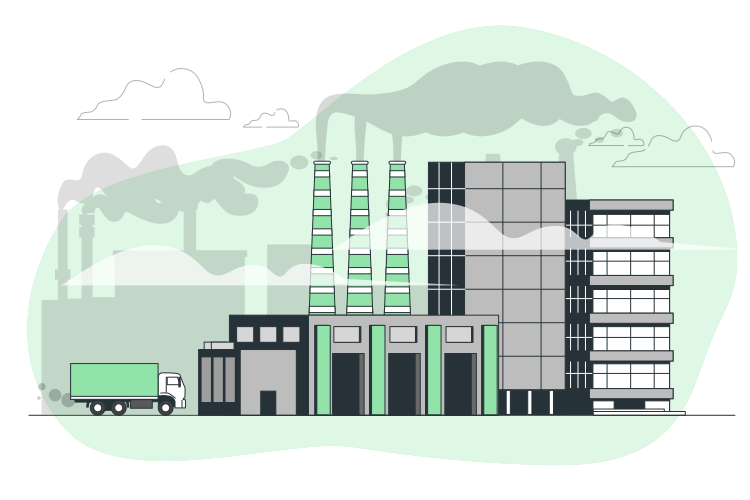
Gas in the grid instead of the air – reducing methane leaks in Bangladesh
Reducing gas leakages within the Bakharad Gas Distribution Network in Bangladesh
The project operates within the natural gas distribution network of the Bakhrabad Gas Distribution Company (BGDCL) in Bangladesh. It is a Leak Detection and Repair (LDAR) project: leaks are systematically identified, measured, and repaired to reduce methane losses from the gas network.
The distribution system covers approximately 4,000 km and spans several districts, including Comilla, Brahmanbaria, Chandpur, Lakshmipur, Noakhali, and Feni.
By detecting and sealing leaks, the project prevents methane from escaping uncontrollably into the atmosphere. Emission reductions are achieved directly at the source where they would otherwise remain “invisible”: diffuse losses within the operating gas distribution network. The project applies an LDAR approach that includes measurement and quantification of leaks (e.g. using high-flow samplers), followed by targeted repair of the identified leak points.
A project that demonstrates how practical maintenance in gas distribution systems can deliver measurable climate benefits—based on established technology, repeatable processes, and a clear focus on real emission sources.
Technical Project Data – VCS2736
Key facts about the methane leakage reduction project in the gas distribution network at a glance.
| Parameter | Description | Source |
|---|---|---|
| Project location | Bangladesh; above-ground gas distribution network of Bakhrabad Gas Distribution Company Limited (BGDCL) in the districts of Comilla, Brahmanbaria, Chandpur, Lakshmipur, Noakhali, and Feni (HQ: Chapapur, Comilla; coordinates documented). | PD, Section 1.12, p. 8; FVR, Section 1.4, p. 9 |
| Project type | Methane reduction project through leak detection and repair (LDAR) in the gas transmission/distribution network (Sectoral Scope 10 – Fugitive emissions from fuels). | PD, Section 1.2, p. 5; FVR, Section 1.4, p. 9 |
| Project standard | Verified Carbon Standard (VCS) (Verra). | PD, Title page, p. 1; FVR, Section 1 (Requirements), p. 8 |
| Project developer | Project Proponent: EcoGas Asia Limited (holder of VCU rights); other parties/financing include Ecoeye Co., Ltd. (as referenced in verification documents). | PD, Section 1.5, p. 6; FVR, Section 1.4, p. 9 & p. 17; FVR, Appendix (Evidence), p. 43 |
| Technology / approach | Systematic leak detection, quantification, and repair using advanced measurement and repair technologies (incl. Hi-Flow Sampler, Gasurveyor) and staff training; focus on valves, flanges, regulators, insulating joints, etc. | PD, Section 1.1, pp. 4–5; FVR, Section 1.4, p. 9; FVR, Appendix (Tech specs), p. 43 |
| Baseline scenario | Without the project: no planned, comprehensive leak detection; repairs mainly for safety reasons; leak detection via smell/soap solution with limited indication of leak size; lack of modern repair materials. | PD, Section 1.13, p. 10 |
| Methodology | CDM methodology AM0023, Version 04.0.0 (applied under VCS as an eligible methodology). | PD, Section 1.1/Footnote & Section 1.3, p. 5; FVR, Section 1 (Requirements), p. 8 |
| Project start | Baseline survey / start date (for project boundary) documented: 28/01/2019 (baseline survey defining the project boundary). | FVR, Section 1.4, p. 17; FVR, Appendix 1.1 (Ref /03/), p. 42 |
| Crediting period | Documented as 10 crediting years in the project documentation (project logic/planning). | PD, Section 1.10, p. 8; FVR, audit history (VCS validation), p. 22 |
| Project status | Verified in the available documentation (monitoring period 01/01/2022–31/12/2022) and issuance requested (VCU issuance possible following successful Verra process). | FVR, Conclusion/Certification statement, p. 42; FVR, Monitoring period, p. 3 |
| Annual emission reductions | For 01/01/2022–31/12/2022: 1,479,035 tCO₂e (verified; ex-ante 1,520,824 tCO₂e, deviation −2.75%). | FVR, ER summary, p. 42 |
| Main impact mechanism | Avoidance of methane emissions by identifying, measuring, and sealing/repairing leaks in gas system components (methane as a highly potent greenhouse gas). | PD, Section 1.1, p. 4; FVR, Section 1.4, p. 9 |
| Monitoring & verification | Monitoring via leak database, GPS/photo evidence, and measurement logs; calibration/QA/QC; independent verification (VVB) including on-site audit and document review. | FVR, Scope/Method, pp. 3–4; FVR, Evidence list, p. 43 |
| Additionality | In the available PD draft, the chapter is marked as “blank”; additionality justification is not included in the excerpt. | PD, Section 3.5, p. 13 |
| Permanence & risk management | No physical permanence issues as in AFOLU projects. Relevant risks mainly relate to data/measurement quality and boundary definition; addressed through calibration, QA/QC, and clear exclusions (no emergency repairs; no “simple” repairs; no new network sections). | PD, Section 1.13, p. 10; FVR, Section 1.4, p. 17; FVR, Appendix/Evidence, pp. 42–43 |
| Carbon credit rating | No external carbon credit rating specified in the available project documents. | Project documentation (PD/FVR) |
| Carbon credit rating type | No project-specific external rating (e.g. BeZero, Sylvera) specified. | – |
| Article 6 authorization (Paris Agreement) | No information provided in the available project documents. | Project documentation (PD/FVR) |
| CCP status (ICVCM) | No information provided in the available project documents. | Project documentation (PD/FVR) |
| Double counting risk management | Declaration/verification that no parallel claims under other programs occurred during the monitoring period; reference to CDM registration (10559), but no CER issuance for the overlapping period (MR marked as “withdrawn” per review). VCUs are registered/serialized via Verra. | PD, Section 1.15, p. 11; FVR, double counting/other programs check, pp. 21–22 |
| Monitoring approach | Recurrent leak detection and measurement (incl. equipment/calibration records), database management (leak code, GPS, photos, raw data), plausibility checks/cross-comparisons; on-site verification with sampling. | FVR, Scope/Method, pp. 3–4; FVR, Evidence list, p. 43 |
| Project lifetime / long-term perspective | Infrastructure/operational project: LDAR processes designed for continuous operation; crediting system described as 10 years in the documentation. | PD, Section 1.10, p. 8; FVR, audit history (VCS validation), p. 22 |
| Contribution to national climate strategy | Practical contribution through methane mitigation in the energy sector (leak detection and repair in the gas distribution network). No Article 6 authorization is indicated in the available project documents. | PD, Section 1.14, p. 10; Project documentation (PD/FVR) |
What the project can contribute
Here we summarize what the project is actually intended to achieve and which practical improvements it can enable.
- 1
Systematically reducing methane leaks
The project targets emissions that often occur “incidentally” in everyday operations: leaks in a gas distribution network. Leaks are specifically identified and subsequently repaired to prevent methane from escaping into the atmosphere.
- 2
Avoiding emissions directly at the source
The climate impact follows a straightforward logic: what does not escape does not cause emissions. Greenhouse gas emissions are therefore avoided directly within the energy sector, with a focus on methane as a particularly potent greenhouse gas.
- 3
Professionalising maintenance in the gas network
Leak detection and repair are established as a recurring process, using modern measurement technology and clearly defined procedures. This improves the quality of maintenance and repair work in the network and makes gas losses more manageable.
- 4
Reducing gas losses and increasing operational efficiency
Leaks do not only cause emissions – they also mean lost gas. When leaks are repaired, these losses are reduced, creating a practical operational benefit alongside the climate impact.
- 5
Establishing measurable and verifiable impact
Leaks are measured and documented (including quantification using appropriate measurement technology). Emission reductions are calculated according to the methodology and independently verified within the standard process. This makes the climate impact traceable – not just claimed.
Global climate relevance
Avoiding methane – a fast climate lever
The project addresses methane leaks in the gas distribution network. Methane is a particularly powerful greenhouse gas, which means every avoided leak makes a direct contribution to limiting global warming.

Climate action at an “invisible” emission source
Many emissions do not only arise from power plants, but also from diffuse losses in energy infrastructure. The project makes this emission source visible – and reduces it through systematic leak detection and repair during ongoing network operations.

Impact through repetition, not a one-off effect
Leak detection and repair are not a single intervention, but a recurring process. This allows emission reductions to continue over time, as long as the measures are applied and maintained in the network.

Enabled by climate finance
Systematic leak detection using modern measurement technology, followed by repairs, is complex and cost-intensive. Financing via the voluntary carbon market helps establish and implement these processes – making climate action practically feasible within the day-to-day operation of energy infrastructure.
Sustainable Development Goals (SDGs) – The relevant and the complementary contributions
In addition to reducing greenhouse gas emissions, the project in Bangladesh helps to reduce methane losses in the gas distribution network, addressing a previously often “invisible” emission source in the energy sector in a practical way. At the same time, maintenance processes within the network are professionalised and technical procedures in ongoing operations are strengthened. As a result, the project supports several objectives of the UN Sustainable Development Agenda (Sustainable Development Goals). The most significant contributions relate to SDG 13 (Climate Action) and, as a secondary effect, SDG 9 (Industry, Innovation and Infrastructure). Other goals are supported in complementary or indirect ways; some SDGs represent marginal contributions and are not core elements of the project.
The project contributes to climate action by systematically identifying and repairing methane leaks in the gas distribution network. This prevents methane, a particularly potent greenhouse gas, from escaping uncontrolled into the atmosphere.
Contribution:
Avoidance of greenhouse gas emissions through the reduction of methane leaks in the energy sector.The project strengthens the quality and reliability of energy infrastructure by establishing maintenance and leak management as a systematic process. Modern measurement and repair technologies, along with standardized procedures, make network losses more controllable.
Contribution:
Strengthening technical infrastructure processes through professional leak detection and repair (LDAR) in the gas network.Leaks do not only cause emissions but also result in lost gas. By reducing leaks, these losses decrease, representing an indirect contribution to more efficient resource use in energy supply.
Contribution:
Indirect reduction of resource losses through the reduction of gas losses in the network.Leak detection, measurement, repair, and documentation require technical work and ongoing operational processes. This can support employment in operation and maintenance activities as a co-benefit rather than a core project objective.
Contribution:
Supporting employment effects through technical operation and maintenance processes.The project does not generate energy itself but can indirectly contribute to more efficient energy supply by reducing the amount of gas lost through leaks. This effect is supportive, but not the central purpose of the project.
Contribution:
Indirect contribution through more efficient energy infrastructure resulting from reduced network losses.
How CO₂ Savings Are Generated
By detecting and sealing leaks, the project prevents methane from escaping from the gas distribution network into the atmosphere. The avoided emissions are measured or quantified and form the basis for CO₂ certificates.
This includes, for example, approaches that capture methane, prevent leakages, or control industrial processes more precisely. The verifiably avoided emissions constitute the basis for CO₂ certificates.
Greenhouse gases often result from technical losses, imprecise processes, or a lack of proper measurement systems. Modern technologies close these gaps: they capture gases that would otherwise be released into the atmosphere or reduce emissions through more efficient operational processes.
Depending on the technology applied, it is calculated how many emissions would have occurred without the measure. Clear factors and defined methodologies are used for this purpose—for example for methane capture, process optimization, or digital monitoring systems.
The difference between “emissions without the project” and “emissions with the project” shows how many greenhouse gas emissions have actually been avoided. These values are reviewed, verified, and regularly updated—and this is how CO₂ certificates are generated.
Context and Transparency
This methane leak reduction project in the gas distribution network is registered under the Verra Verified Carbon Standard (VCS) and is regularly monitored and independently verified within the framework of the standard. The reported emission reductions are based on verified monitoring reports and the recognized methodology AM0023 (Leak Detection and Repair), which is used to calculateemissions avoided through the detection and repair of leaks in the gas network compared to the baseline scenario.
Legally secure offsetting and measurable impact
In times of stricter regulations, climate protection is no longer a matter of goodwill, but of legal security. natureOfficesupports companies in minimizing greenwashing risks and communicating sustainability transparently. Everything starts with a reliable database: We create your Corporate Carbon Footprint (CCF) and Product Carbon Footprint (PCF)according to international standards. This forms the foundation for your sustainability reports (e.g., according to VSME) and legally secure sustainability communication.
A critical point for companies is legally secure offsetting. Through the use of modern hydropower technologies, we promote an emission-free global energy infrastructure. These technological projects are an essential lever for decarbonization and meet the highest requirements for additionality and transparency – crucial for meeting the requirements of the Green Claims Directive.
The quality of our approach is evident in our own PROJECT TOGO. Here, we combine climate protection with a social transformation that directly contributes to 12 of the 17 SDGs.
Whether through high-quality carbon credits or individual strategies: We offer solutions that combine technological innovation with social impact and guide your company to the regulatory safe side.