
Stopping methane instead of letting it escape – landfill gas project in Uberlândia
Uberlandia Landfills I and II, Brazil
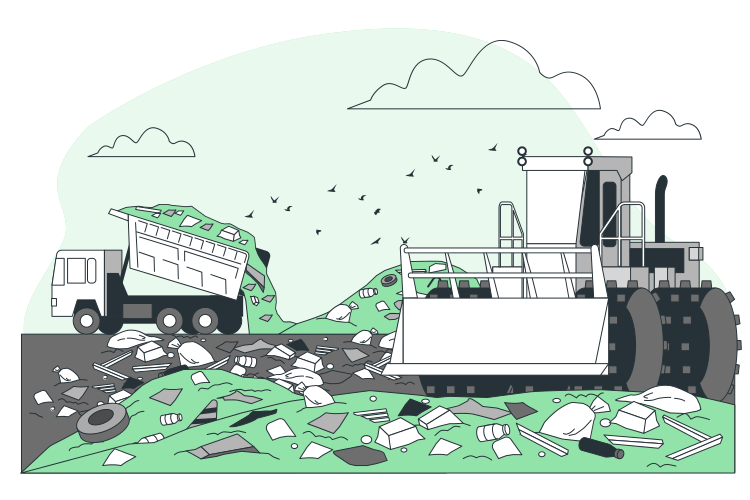
The landfill gas project in Uberlândia (Minas Gerais, Brazil) targets emissions that would otherwise often “just happen”: at a landfill, where organic waste decomposes underground, producing methane that can escape uncontrolled. The goal is to systematically capture this landfill gas—and to destroy the climate driver methane in a controlled way.
Specifically, the gas is extracted via a collection system and then destroyed in a high-temperature flare and/or used in engines to generate electricity. This prevents methane from reaching the atmosphere—and it can also produce electricity fed into the grid, where it can displace conventional generation on a calculated basis.
A project that shows how practical infrastructure can tackle a very real problem: less methane from waste, more controlled treatment—and climate impact exactly where it would otherwise be hard to see.
Technical project data – GS 3434
Key facts about the landfill gas project at a glance.
| Parameter | Description | Source |
|---|---|---|
| Project location | Brazil; State of Minas Gerais; City of Uberlândia (Distrito Industrial II); project boundary and coordinates documented. | PDD, Section A.2, p. 2 |
| Project type | Landfill gas project: capture of methane emissions from a landfill with destruction (flaring) and partial electricity generation; waste sector with an energy component. | PDD, Section A.1, p. 1 |
| Project standard | Gold Standard for the Global Goals (GS4GG). | Project Registration / GS Passport, p. 1 |
| Project developer | Landfill operator Limpebrás Resíduos Ltda.; project implementation and representation, among others, by Energas Geração de Energia Ltda. and Asja Brasil. | PDD, Section A.1, p. 1 |
| Technology / approach | Collection of landfill gas via well and piping systems; destruction in a high-temperature flare and use in gas engines for electricity generation (3 engines, total approx. 4.3 MW); grid export. | PDD, Section A.1, pp. 1–2 |
| Baseline scenario | Without the project, landfill gas would escape uncontrolled; methane emissions would be released directly to the atmosphere without capture and treatment. | PDD, Section B.1, p. 6 |
| Methodology | ACM0001 – Flaring or use of landfill gas (Large Scale), including the associated tools. | PDD, Section A.3, p. 3 |
| Project start | Project activity start in 2011; flaring operation from 2012; electricity generation from landfill gas since 2012, expanded by an additional engine from 2020. | PDD, Section C.1.1, p. 11 |
| Crediting period | Several consecutive crediting periods within the maximum overall Gold Standard duration of up to 15 years. | PDD, Section A.4, p. 4 |
| Project status | Project in ongoing operation; originally registered under the CDM, later transitioned to Gold Standard (GS4GG); regular verification and issuance. | Monitoring Report, Executive Summary |
| Annual emission reductions | Emission reductions from avoided methane emissions as well as from electricity generation from landfill gas; amounts reported per monitoring period. | Monitoring Report, Emission Reduction Summary |
| Main impact mechanism | Avoidance of methane emissions through capture and destruction/use of landfill gas, plus additional displacement of fossil electricity generation through grid export. | PDD, Section A.1 & B.1 |
| Monitoring & verification | Continuous monitoring of gas quantity, methane content, flare and engine operation, and electricity export; independent verification within the GS process. | Monitoring Report, Section D |
| Additionality | Additionality demonstrated using recognized tools for baseline and additionality assessment. | PDD, Section B.5, pp. 8–9 |
| Permanence & risk management | No permanence risk as in AFOLU projects; key risks relate to measurement and operational performance and are addressed through monitoring and QA/QC. | Monitoring Report, Section D |
| Carbon credit rating | No external carbon credit rating stated. | Project information |
| Carbon credit rating type | No project-specific external rating (e.g., BeZero, Sylvera). | Project information |
| Article 6 authorization (Paris Agreement) | No information provided on Article 6 authorization. | Project information |
| CCP status (ICVCM) | No CCP classification stated. | Project information |
| Approach to double-counting risks | Transition from CDM to Gold Standard documented; no parallel credits claimed for identical emission reductions. | Monitoring Report, Section A |
| Monitoring approach | Systematic recording of all relevant gas and electricity parameters; periodic reporting and independent review. | Monitoring Report, Sections D.1–D.3 |
| Project lifetime / longevity | Expected technical lifetime of the plant approx. 20–21 years; long-term operation designed across multiple crediting periods. | PDD, Section C.1.2, p. 11 |
| Contribution to national climate strategy | Contribution to emission reductions in Brazil’s waste sector and to renewable electricity generation within the power system. | PDD, Section A.1 |
What the project can contribute
Here we summarize what the project is actually intended to achieve and which practical improvements it can enable.
- 1
Effectively reduce methane emissions from the landfill
Methane generated at the landfill is deliberately captured instead of being released uncontrolled. The project intervenes exactly where emissions would otherwise “just happen,” reducing one of the most powerful climate drivers directly at the source.
- 2
Treat landfill gas in a controlled way instead of letting it escape
Collection systems, flaring, and gas engines bring landfill gas under technical control. This improves overall landfill operations—less odour, more control, and fewer diffuse losses.
- 3
Feed electricity from landfill gas into the regional grid
Part of the captured gas is used to generate electricity. The electricity is exported to the public grid and can displace conventional generation on a calculated basis—an additional benefit beyond methane avoidance alone.
- 4
Improve landfill safety and operational quality
Systematic gas capture reduces risks such as gas build-up or uncontrolled ignition. At the same time, operating procedures are professionalised and continuously monitored.
- 5
Create lasting operations and service effects in the region
Ongoing operation requires technology, maintenance, measurement, control, and qualified personnel. These are recurring tasks—creating stable regional effects in day-to-day waste management, not just a one-off construction project.
Global climate relevance
Stopping methane where it inevitably forms
Waste is generated worldwide—and so is landfill gas. The key issue is not whether methane forms, but how it is managed. The project addresses this unavoidable source and prevents the gas from escaping uncontrolled into the atmosphere.

High climate impact with a comparatively focused intervention
Compared with many other climate measures, landfill gas projects are technically well defined: a clear source, well-understood processes, and measurable outcomes. This makes them an efficient lever for achieving relevant emission reductions in the near term.

Relieving the climate system at a critical time
Methane has a particularly strong effect in the first decades after it is released. Every emission avoided today helps slow near-term warming—an important contribution to reducing pressure on climate tipping points.

A transferable model for many countries
Landfills exist everywhere—especially around fast-growing cities in the Global South. The project is an example of an approach that is technically proven, scalable, and transferable internationally. That is where its global relevance lies.
Sustainable Development Goals (SDGs) – The relevant and the complementary contributions
Beyond reducing greenhouse gas emissions, the Uberlândia landfill gas project contributes to more climate-friendly waste management, emission reductions in the energy sector, and improved operational standards at the landfill. The main contributions relate to SDG 13 (Climate Action) and SDG 7 (Affordable and Clean Energy). Additional goals are supported in a secondary or indirect way. Some SDGs are best understood as marginal contributions—relevant as co-effects, but not anchored in the project’s core purpose.
The project captures methane from the landfill and prevents it from escaping uncontrolled into the atmosphere. Methane is a particularly powerful greenhouse gas; controlled capture and use therefore deliver direct and effective emission reductions.
Contribution:
Avoidance of greenhouse gas emissions by reducing methane releases from waste management.The captured landfill gas is used for energy generation and converted into electricity. This renewable electricity is fed into the local grid and can displace fossil-based power generation on a calculated basis.
Contribution:
Generation of renewable energy from waste gases and support for power supply without additional fossil fuels.Controlled landfill gas capture improves landfill operations and environmental performance. This can reduce emissions, odours, and safety risks in the area surrounding the landfill.
Contribution:
Improved environmental and safety standards in municipal waste management.The project establishes technical systems for gas capture, treatment, and electricity generation. This builds modern infrastructure across the waste and energy sectors and keeps it operating over the long term.
Contribution:
Strengthening technical infrastructure and professional operational processes in waste management and energy supply.Operating, maintaining, and monitoring the gas facilities and electricity generation require skilled staff and ongoing services.
Contribution:
Complementary employment and service effects linked to operation of landfill gas and energy facilities.Using landfill gas for energy supports more efficient use of waste streams. Waste is not only disposed of, but also used as an energy source.
Contribution:
Indirect contribution to more resource-efficient waste management through the use of residual gases.By capturing landfill gas in a controlled way, risks from uncontrolled gas emissions and potential local air pollution are reduced.
Contribution:
Indirect health benefit through improved emissions control in landfill operations.
How CO₂ Savings Are Generated
Captured methane is used for energy instead of being released into the atmosphere. The resulting avoided emissions can be quantified and form the basis for carbon credits.
At the landfill, methane is produced as organic waste decomposes. Without mitigation measures, this gas would escape uncontrolled into the atmosphere. Methane is a particularly powerful greenhouse gas and contributes much more strongly to warming in the near term than CO₂.
In the Uberlândia project, landfill gas is deliberately captured and used for energy. The methane is collected and used to generate electricity instead of reaching the atmosphere. Climate impact is created in two ways:
– by avoiding methane emissions, and
– by generating electricity that displaces fossil-based power generation in the grid.
The level of emission reductions is calculated based on the actual volumes of gas captured and the energy generated. This takes into account how much methane would have been released without the project and which additional emissions are avoided through electricity generation.
These savings are measured, documented, and regularly independently verified. On this basis, the project’s carbon credits are issued.
Context and Transparency
This landfill gas project is registered under the Gold Standard for the Global Goals (GS4GG) and is regularly monitored and independently verified in accordance with the standard. The reported emission reductions are based on audited monitoring reports and an approved methodology for capturing and quantifying avoided methane emissions through the controlled collection and use of landfill gas.
Legally secure offsetting and measurable impact
In times of stricter regulations, climate protection is no longer a matter of goodwill, but of legal security. natureOfficesupports companies in minimizing greenwashing risks and communicating sustainability transparently. Everything starts with a reliable database: We create your Corporate Carbon Footprint (CCF) and Product Carbon Footprint (PCF)according to international standards. This forms the foundation for your sustainability reports (e.g., according to VSME) and legally secure sustainability communication.
A critical point for companies is legally secure offsetting. Through the use of modern hydropower technologies, we promote an emission-free global energy infrastructure. These technological projects are an essential lever for decarbonization and meet the highest requirements for additionality and transparency – crucial for meeting the requirements of the Green Claims Directive.
The quality of our approach is evident in our own PROJECT TOGO. Here, we combine climate protection with a social transformation that directly contributes to 12 of the 17 SDGs.
Whether through high-quality carbon credits or individual strategies: We offer solutions that combine technological innovation with social impact and guide your company to the regulatory safe side.