
Wind in the grid instead of fossil fuels in the mix – electricity from West Huaybong
West Huaybong 3 Wind Farm Project, Thailand
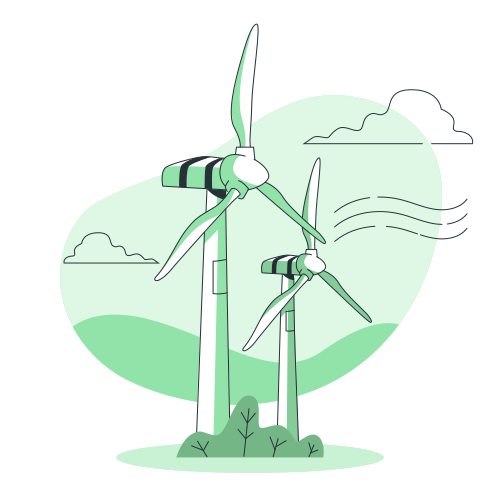
The West Huaybong 3 project is located in Nakhon Ratchasima Province, Thailand (including the areas of Huaybong and Nong Wang). It is a grid-connected wind farm with an installed capacity of 103.5 MW (45 wind turbines with a capacity of 2.3 MW each) and feeds the generated electricity into the Thai national grid.
By feeding wind-generated electricity into the grid, electricity from the existing grid mix can be displaced on a calculated basis—electricity that would otherwise partly come from emission-intensive conventional generation. This is where the climate impact occurs: within the power system itself. The actual volumes of electricity fed into the grid are measured and documented, allowing the resulting avoided emissions to be transparently and reliably quantified in accordance with methodology ACM0002.
The project demonstrates how wind energy contributes to a more climate-friendly electricity supply as a reliable part of the energy infrastructure—through ongoing operation, a clear displacement logic, and measurable impact via grid injection.
Technical project data – GS 7746
Key facts about the wind energy project at a glance
| Parameter | Description | Source |
|---|---|---|
| Project location | Thailand; Nakhon Ratchasima Province (including Tambol Huaybong / Amphur Dan Khun Thot and Tambol Nong Wang / Amphur Thepharak; coordinates specified in the project documentation). | Section A (Location), pp. 4–6 |
| Project type | Grid-connected onshore wind power project (large-scale); electricity supplied to the national grid. | Section A.1, p. 4 |
| Project standard | Gold Standard for the Global Goals (GS4GG); product type: GS VER. | Executive Summary / Scope, pp. 2–3 |
| Additional standard | No additional standard specified. | Project documentation |
| Project developer | Project Participant / Project Owner: First Korat Wind Company Limited; Project Representative: Kosher Climate India Pvt. Ltd. | Basic Information, pp. 1–2 |
| Technology / approach | Operation of a wind farm with 45 wind turbines (2.3 MW each; total capacity 103.5 MW); renewable electricity is supplied to and sold via the Thai national grid. | Section A.1, p. 4 |
| Baseline scenario | In the absence of the project, the equivalent amount of electricity would be supplied by the existing Thai grid mix, including fossil-based generation. | Section B.1, p. 8 |
| Methodology | ACM0002 – Grid-connected electricity generation from renewable sources (version 20.x applied in monitoring and reporting). | Section A.3, pp. 7–8 |
| Project start | Start date: 15 August 2011; commissioning date: 14 November 2012. | Project Milestones, pp. 4–5 |
| Crediting period | Current (renewed) crediting period: 1 December 2019 – 30 November 2024 (5 years). | Crediting Period, pp. 3–5 / p. 8 |
| Project status | Registered Gold Standard project; monitoring and independent verification documented for the monitoring period 1 November 2021 – 31 December 2023. | Executive Summary, p. 2 |
| Annual emission reductions | For the period 1 November 2021 – 31 December 2023: 241,701 tCO₂e reported (with annual/vintage breakdown provided in the documentation). | Table “SDG 13 / Product Vintages”, p. 3 |
| Main impact mechanism | Displacement effect: each kWh of wind electricity supplied to the grid can replace electricity from the grid mix, resulting in avoided emissions in the power sector. | Section B.1, p. 8 |
| Monitoring & verification | Measurement of electricity supplied to the grid via meters at the grid connection point; independent verification including document and evidence review. | Objectives / Scope, p. 2 |
| Additionality | Additionality is assessed within the Gold Standard process; the validation report confirms that the emission reductions are additional. | Executive Summary, p. 3 |
| Permanence & risk management | No AFOLU-related permanence risk (no buffer account required). Relevant risks mainly relate to accurate measurement, data management and verification quality. | Scope / Approach, pp. 2–3 |
| Carbon credit rating | No external carbon credit rating indicated in the available project documentation. | Project documentation |
| Carbon credit rating type | No project-specific external rating (e.g. BeZero, Sylvera) reported. | – |
| Article 6 authorisation (Paris Agreement) | No Article 6 authorisation indicated in the available project documentation. | Project documentation |
| CCP status (ICVCM) | No CCP classification indicated in the available project documentation. | Project documentation |
| Handling of double-counting risks | CDM registration disclosed (CDM 7474); registrations and time periods are transparently described; ownership and claims to emission reductions are documented. | Section A.1, pp. 4–5 |
| Monitoring approach | Monitoring of grid electricity via primary and backup meters (maximum error margin according to documentation: ±0.2%); data processing in line with the monitoring plan; verification through evidence cross-checks. | Section B.1, p. 9 |
| Project lifetime / long-term operation | Design lifetime of turbines: 20 years; planned operational lifetime of the project: approx. 23 years. | Section B.1, pp. 8–9 |
| Contribution to national climate strategy | Contribution through additional renewable electricity generation and displacement of fossil-based power generation, supporting decarbonisation of the electricity mix. | Section A.1 & Section B.1, pp. 4 & 8 |
What the project can contribute
Here we summarize what the project is actually intended to achieve and which practical improvements it can enable.
- 1
Expanding renewable electricity in the Thai grid
West Huaybong 3 supplies wind-generated electricity to the public power grid in Thailand. In doing so, it strengthens renewable generation as a permanent infrastructure component of the energy system—not as a one-off measure.
- 2
Avoiding emissions in the power sector
The climate impact is created through displacement: every kilowatt-hour of wind electricity fed into the grid can, on a calculated basis, replace electricity from the existing grid mix. This avoids emissions that would otherwise arise from conventional power generation within the grid.
- 3
Diversifying the electricity mix and reducing fossil dependency
More wind power means a broader and less fossil-based electricity mix. The project supports a gradual transformation of the energy system—without claiming to single-handedly “turn around” the national power mix.
- 4
Strengthening regional value creation during operation
Operating and maintaining a wind farm requires ongoing technical services, spare parts, maintenance processes and personnel. These are recurring, local economic effects that accompany the climate impact of an infrastructure project.
- 5
Building local infrastructure and operational routines
A wind farm establishes permanent, recurring processes: safety standards, maintenance schedules, spare parts logistics and grid connection management. This operational routine makes renewable electricity generation a normal part of the system and strengthens regional capabilities to operate such installations over the long term.
Global climate relevance
Decarbonising the power sector – a global lever
Globally, the power sector is one of the largest sources of greenhouse gas emissions. Every additional kilowatt-hour of wind electricity supplied to the grid can, on a calculated basis, replace emission-intensive conventional generation—reducing emissions exactly where they are systemically generated.

Renewable energy as a foundation for electrification
Wind energy does not operate at the margins of the system, but at its core: grid electricity. This is globally relevant because a cleaner power supply is a prerequisite for the long-term electrification of other sectors such as mobility, heating and industry.

Impact over years instead of a one-off effect
A wind farm is infrastructure. As long as it is in operation, it continuously supplies renewable electricity—and continuously avoids emissions that would otherwise repeatedly arise within the electricity mix.

Additional impact through climate finance
Large-scale wind projects require high upfront investments and long-term operational security. Revenues from the climate finance market can help secure the economic viability of such installations and enable renewable generation to be deployed earlier or more reliably than would be possible without this support.
Sustainable Development Goals (SDGs) – The relevant and the complementary contributions
In addition to reducing greenhouse gas emissions, the West Huaybong 3 wind project contributes to strengthening electricity supply and reducing emissions in Thailand’s power sector. In doing so, the project supports several objectives of the United Nations Sustainable Development Goals (SDGs). The primary contributions relate to SDG 7 (Affordable and Clean Energy) and SDG 13 (Climate Action). Further goals are supported on a complementary basis, mainly through operation, maintenance and associated activities.
The project generates electricity from wind energy and feeds it into the public power grid. In this way, renewable generation capacity is strengthened within the electricity system—as permanent infrastructure, not as a one-off effect.
Contribution: Expansion of renewable electricity generation and support for electricity supply security.By feeding wind-generated electricity into the grid, emission-intensive electricity generation can be displaced on a calculated basis. The resulting emission reductions occur directly within the power sector—where electricity is actually produced and supplied.
Contribution: Reduction of greenhouse gas emissions through renewable electricity generation.The operation and maintenance of a wind farm require ongoing technical services, maintenance processes and personnel. This leads to recurring employment and value creation effects associated with the operation of the installations.
Contribution: Supporting employment effects in operation and technical services.Renewable electricity replaces conventional generation based on combustion processes, indirectly contributing to lower air-pollutant-intensive power generation. In addition, occupational safety standards and structured operational processes play a role in day-to-day plant operation.
Contribution: Indirect contribution through cleaner electricity generation and health and safety aspects in operation.
How CO₂ Savings Are Generated
Clean electricity from renewable energy projects replaces fossil-based power. The emissions avoided through this shift can be measured and form the basis for issuing carbon credits.
Renewable power changes the overall energy mix: every kilowatt hour produced by wind, solar or hydropower reduces the need for electricity from coal, gas or oil.
The amount of CO₂ emitted per kilowatt hour varies by country and by fuel type. These official grid emission factors make it possible to calculate how much CO₂ would have been released without the renewable energy project.
For each project, the expected fossil share is compared with the clean electricity actually delivered. The difference shows the verified emission reductions — the real CO₂ savings. These values are reviewed by independent auditors, updated regularly, and form the certified basis for carbon credits.
Context and Transparency
This wind energy project is registered under the Gold Standard for the Global Goals (GS4GG) and is subject to regular monitoring and independent verification in accordance with the standard. The reported emission reductions are based on audited monitoring reports and the recognised ACM0002 methodology, which is used to calculate emissions avoided through grid-connected wind power compared to conventional electricity generation within the grid.
Legally secure offsetting and measurable impact
In times of stricter regulations, climate protection is no longer a matter of goodwill, but of legal security. natureOfficesupports companies in minimizing greenwashing risks and communicating sustainability transparently. Everything starts with a reliable database: We create your Corporate Carbon Footprint (CCF) and Product Carbon Footprint (PCF)according to international standards. This forms the foundation for your sustainability reports (e.g., according to VSME) and legally secure sustainability communication.
A critical point for companies is legally secure offsetting. Through the use of modern hydropower technologies, we promote an emission-free global energy infrastructure. These technological projects are an essential lever for decarbonization and meet the highest requirements for additionality and transparency – crucial for meeting the requirements of the Green Claims Directive.
The quality of our approach is evident in our own PROJECT TOGO. Here, we combine climate protection with a social transformation that directly contributes to 12 of the 17 SDGs.
Whether through high-quality carbon credits or individual strategies: We offer solutions that combine technological innovation with social impact and guide your company to the regulatory safe side.