
CO₂ data for printers – clear and traceable
We support printing companies in calculating emissions accurately, structuring data clearly, and communicating it with confidence.
Does this sound familiar?
Your day is already full – and now CO₂ data is added on top
Tight deadlines, narrow margins, rising material costs, demanding customers. Day-to-day operations in a print shop are already complex enough. And then come additional requirements: CO₂ data in quotes, questions in tenders, follow-ups from clients.
Suddenly, it’s no longer just about quality, price, and delivery time – but also about emissions per product.
The data is often already there. But it’s scattered, needs to be collected and structured. And exactly when things need to move fast – that’s when the real work begins.
What’s missing is not experience. It’s a structure that brings data together, makes it traceable, and available at the right moment.
That’s exactly where our software ecozoom comes in.
CO₂ data where you need it: in quotes, conversations, and orders
Capturing CO₂ data is one thing. Having it available at the right moment is another. With ecozoom, you calculate traceable CO₂ values for your print products – based on your production data, without manual data collection.
With ecozoom.print, you structure the relevant parameters of your production:
Paper. Printing process. Finishing. Transport
Based on this, each product gets a clear, traceable carbon footprint –
ready to use immediately.
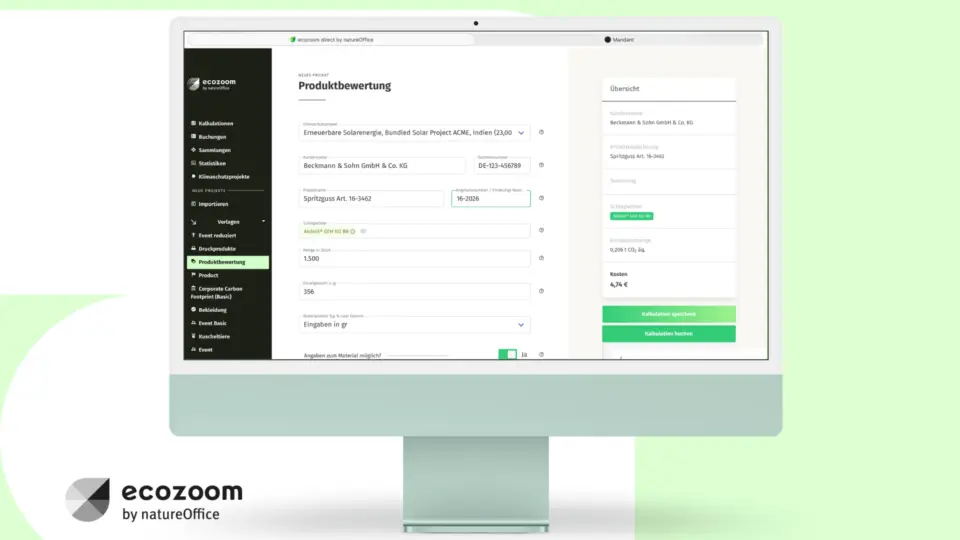
What used to be scattered values and Excel files becomes a clear process.
Capturing CO₂ data is one thing. Having it available at the right moment is another. With ecozoom, you calculate traceable CO₂ values for your print products – based on your production data.
What actually changes
Everything in one place. And easy to find.
CO₂ values for individual print products are available instantly – without detours and without having to piece data together again.
Parameters such as paper choice, print run, or printing process are properly accounted for and clearly represented. Questions about the calculation and its composition can be answered at any time – based on solid data.
At the same time, the results are ready to use immediately – whether in quotes, tenders, or your documentation.
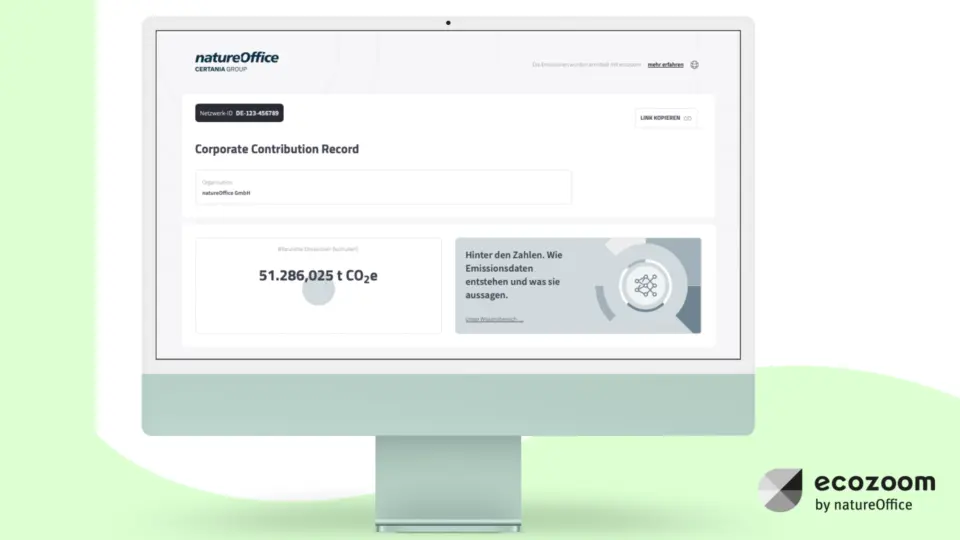
What changes in your daily work
The difference doesn’t show in the tool – it shows in your everyday operations.

CO₂ values you can explain
You don’t just provide numbers – you can clearly explain their origin and composition, even in response to questions from clients or auditors.

Lower risk in communication
You reduce the risk of unclear or vulnerable claims and create a solid foundation for your communication.

Faster responses in day-to-day business
Requests for CO₂ data can be answered directly – whether in quotes, tenders, or customer conversations.

Better production decisions
You understand how paper choice, print run, or processes impact the carbon footprint – and can compare and optimize accordingly.
What ecozoom actually covers
All relevant steps around CO₂ data are brought together in one system – from calculation to sharing.
- 1
CO₂ calculation for your print products
Calculation of the Product Carbon Footprint based on your production data – from paper and printing to finishing.
- 2
Compare scenarios
Make differences visible – for example in paper choice, print run, or process – directly and transparently.
- 3
Factsheets at the push of a button
All key figures clearly prepared – for clients, internal coordination, or external audits.
- 4
Proof & labeling
CO₂ data prepared so it can be communicated clearly and verified when needed.
- 5
Central data access
A shared data base instead of scattered individual values – including import and export options.
- 6
Efficient handling of recurring jobs
Defined products or processes can be reused – without recalculating everything from scratch.
- 7
Team collaboration
Everyone works with the same data – no version chaos, no email back-and-forth, with clear responsibilities.
The difference shows in practice
ecozoom wasn’t built as just another tool – it was developed from the real-world workflows of printing companies.
The logic behind it is designed to structure CO₂ data so that it is not only calculated, but also communicated and documented with confidence.
In Germany, ecozoom is one of the few specialized solutions for printing companies – and was among the first systems with end-to-end CO₂ tracking for full traceability.
Since 2008, CO₂ calculation, documentation, and communication have been part of our core business in the print industry.
Instead of isolated analyses or Excel-based solutions, this creates a consistent data foundation – with integrated proof and a clear structure.
How this shows in day-to-day operations
1. Create a quote → CO₂ values are included directly
2. Customer asks → answers are immediately available
3. Audit or review → export structured data
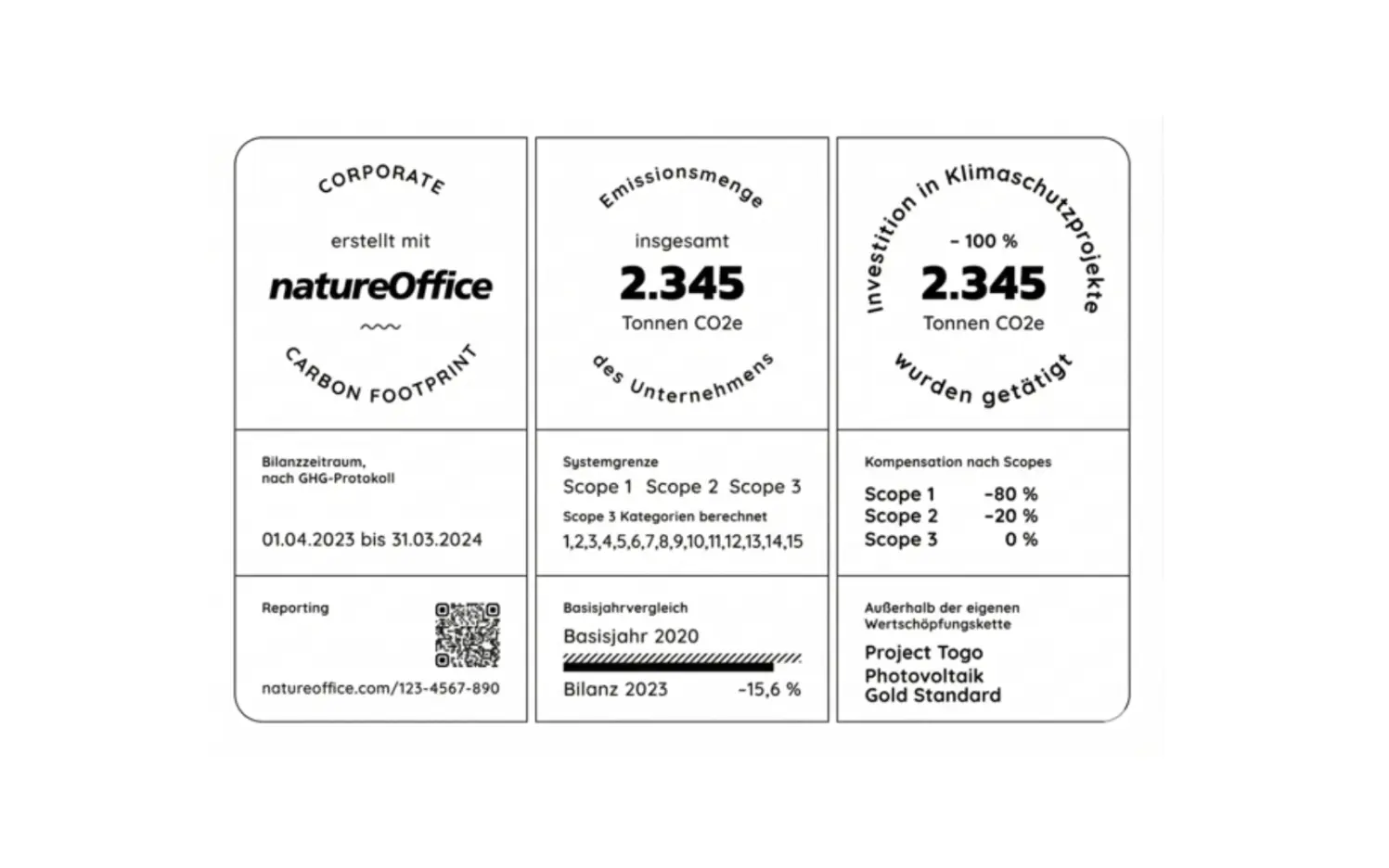
Variants of the natureOffice label
Three versions of the natureOffice label are available for different applications. Which version is used depends on the respective medium.

How the label works
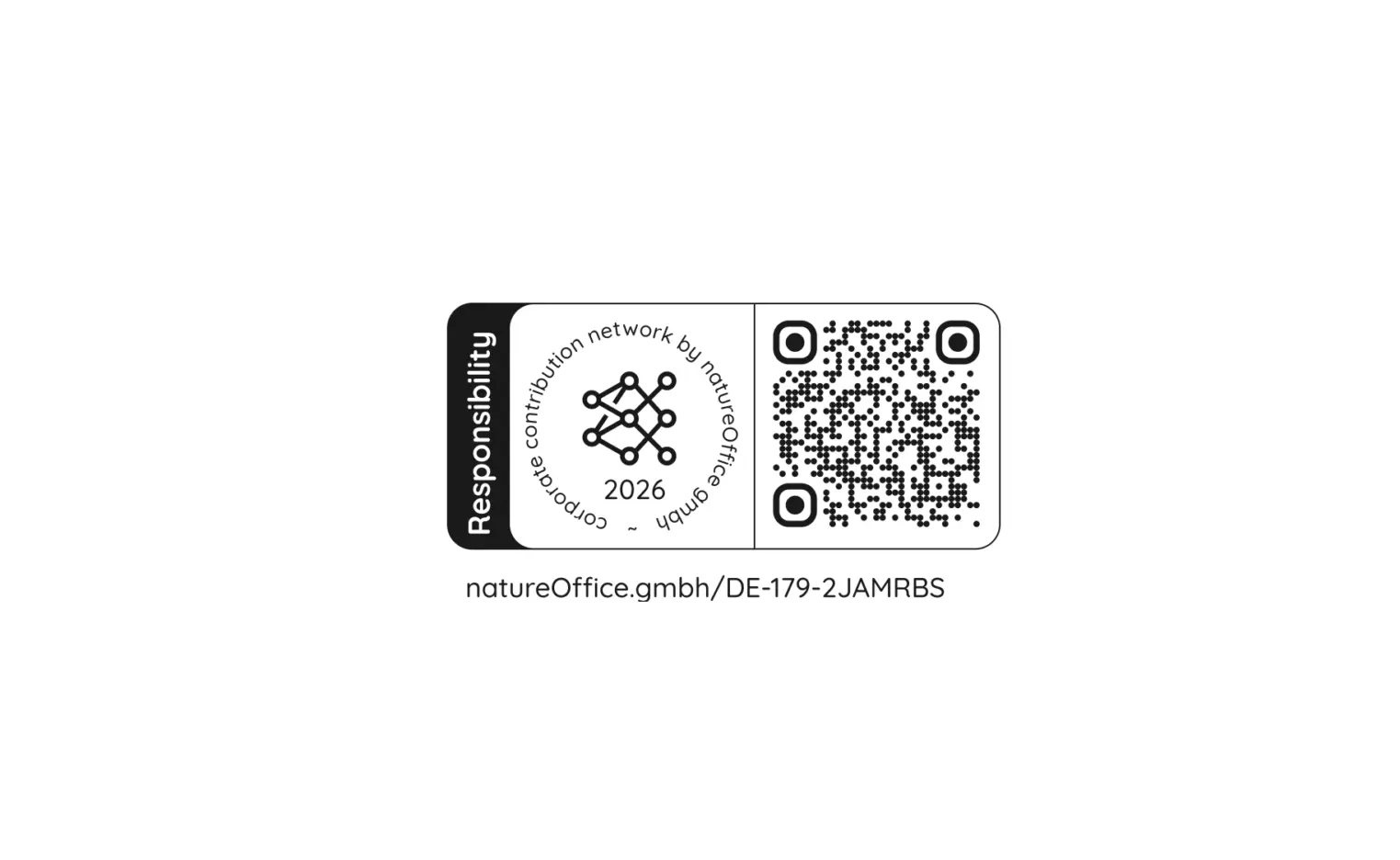
From the label to the digital record – this is how the associated information becomes visible.
- 1
Label
The natureOffice label is used on products, websites or in company information. It indicates that a documented entry for this product or company exists within the network.
- 2
QR Code / Network ID
Each label contains a QR code and a unique Network ID. Both lead to the digital record where the associated information is stored.
- 3
Corporate Contribution Record
By scanning the QR code, users are taken directly to the Corporate Contribution Record. This record serves as the central access point for the documented information of a company.
- 4
Documented Information
Within the Corporate Contribution Record, the provided information is presented in a structured format. This may include, for example, emission data or information on project-related investments.
What happens to the emissions?
Carbon offsetting is not a label – it’s a tool
Offsetting does not undo climate impact. But it shows
how remaining emissions are handled.
And that’s the point:
→ Offsetting is not a label, but a way to deal with residual emissions
→ It does not replace reduction, but also does not conflict with EU regulations
→ It makes emissions visible – instead of ignoring them
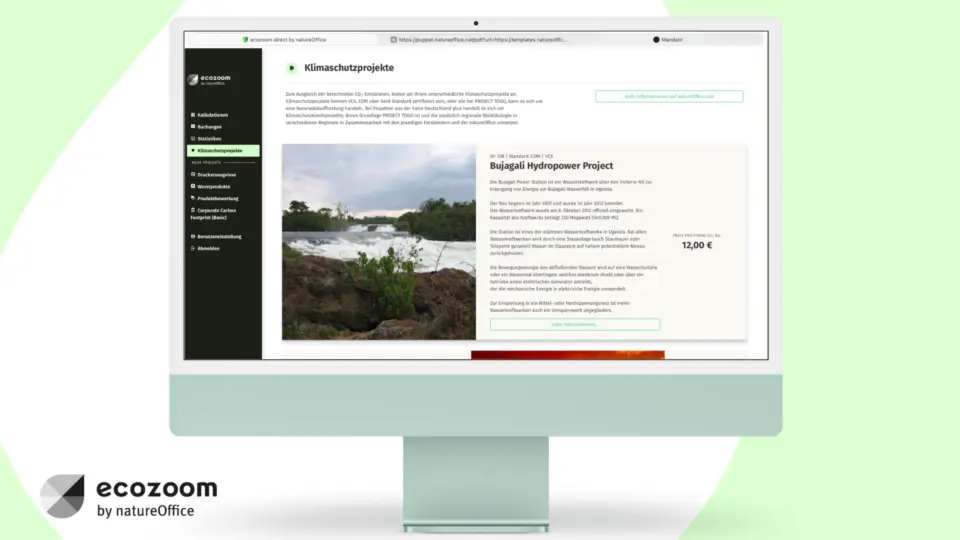
Carbon footprint software for printing companies: calculate PCF, use data, meet requirements
Printing companies are increasingly required to capture carbon data in a structured way and make it usable in daily operations. Whether for quotes, tenders, or customer discussions – reliable product carbon footprint (PCF) data for print products is becoming standard.
Specialized carbon footprint software for printing helps calculate emissions across the entire production process – from paper and printing methods to finishing, transport, and disposal. Data is consolidated in one place, clearly structured, and ready to use for quotes, documentation, or follow-up questions.
While many requirements focus on the carbon footprint of individual print products (PCF), the corporate carbon footprint (CCF) is becoming increasingly relevant for printing companies – for example in the context of CSRD, supply chain requirements, or internal management. Both approaches follow established standards such as the GHG Protocoland can be effectively combined.
In the print industry, modern carbon accounting software is replacing isolated Excel-based solutions. It reduces manual effort, creates a consistent data foundation, and ensures that carbon data is consistent, verifiable, and ready for further use – for reporting, customer requirements, or external audits.
The result is a solid foundation for managing carbon data in printing companies – from calculation and evaluation to clear and traceable communication.