
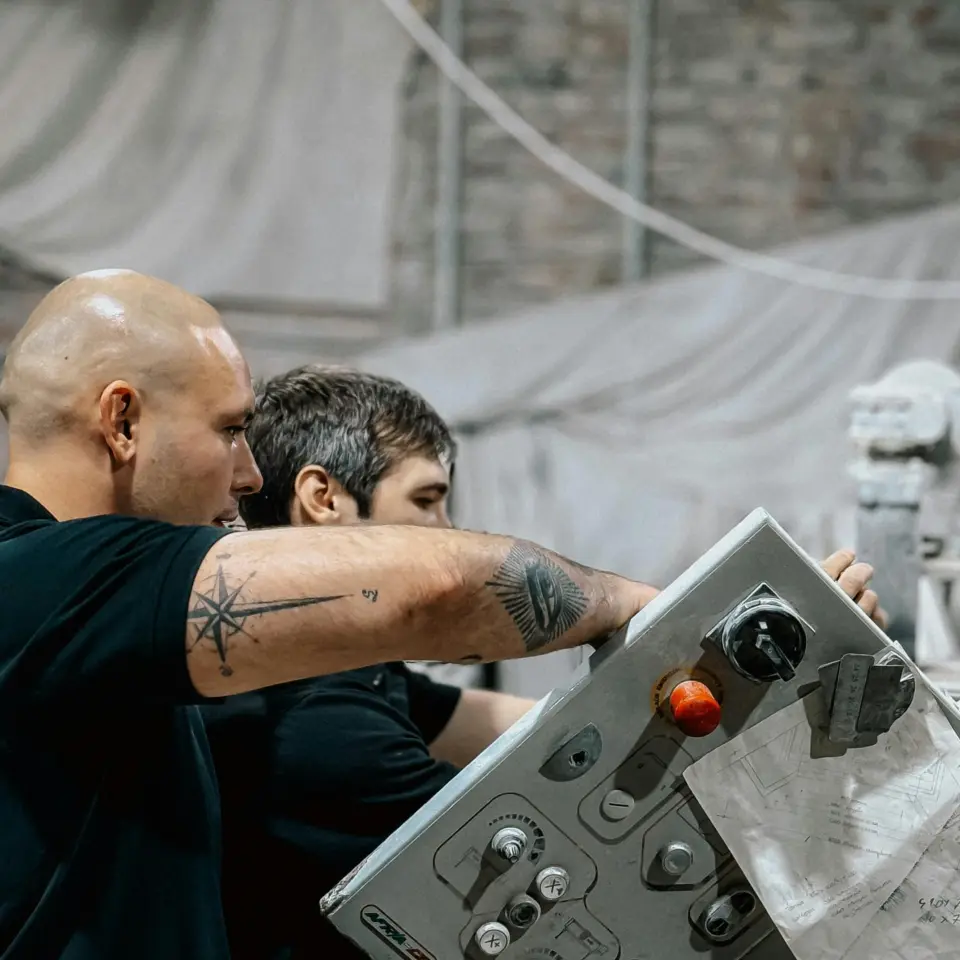
For processes you already know.
Not a generic tool – but a solution that works.
Our approach to carbon accounting doesn’t follow abstract logic.
It follows what actually happens in your day-to-day operations.
Data is generated along your processes –
and that’s exactly where it is captured, structured and analysed.
Step by step, this creates a consistent overall picture
that you can use internally and share externally.
Is your industry not listed?
From data capture to usable results. In one clear system.
What is often fragmented and manual today becomes a consistent process – transparent, repeatable and ready to shar
| What happens | What changes | What you get |
|---|---|---|
| → Data is captured – manually or via import | → less manual calculation effort | → carbon footprints (e.g. per order, product or period) |
| → Processes are structured and mapped | → clear and consistent data structure | → understandable reports for internal and external use |
| → Emissions are calculated automatically | → logic can be reused once established | → data that can be shared directly |
| → Industry-specific templates support setup | → less coordination effort between stakeholders | → transparent documentation of assumptions and results |
| → Integrated emission factors are ready to use | → less improvisation when requirements change | → consistent data for customers, tenders and reporting |
| → Automated evaluation reduces intermediate steps | → more reliability in recurring tasks | → results that remain usable over time |
Getting started is straightforward
Even with complex products, you don’t need to be a PCF expert to begin. The software guides you step by step – and we support you along the way. How to get started.
- 1
Introduction
We present the software based on your products and requirements.
- 2
Setup
Together, we define how your products and data are structured.
- 3
Access
You receive access to a prepared system.
- 4
Start
You begin working with the software and build your product carbon footprints step by step.
CO₂ software for CCF and PCF: clarity for companies and products
Companies today face the challenge of capturing CO₂ data in a structured way and making it usable. Whether for a Corporate Carbon Footprint (CCF) or a Product Carbon Footprint (PCF), reliable data is the foundation for reporting, product information and sound decision-making.
CO₂ software supports this by systematically calculating emissions, consolidating data sources and presenting results in a transparent and traceable way. While a CCF covers emissions across an entire company (Scope 1, 2 and 3), a PCF focuses on individual products, processes or variants throughout their lifecycle. Both approaches follow established standards such as the GHG Protocol and can be combined depending on the use case.
Especially for SMEs, modern carbon accounting software is increasingly replacing Excel-based solutions. It creates transparency, reduces coordination effort and ensures that CO₂ data remains consistent, verifiable and ready for further use – for example in CSRD reporting, digital product passports or supply chain requirements.
With the right CO₂ software, companies build a solid data foundation that is not only calculated, but also understood and ready to be used – internally, with customers and in discussions with auditors or financial partners.