
PROJECT TOGO PLUS · WATER
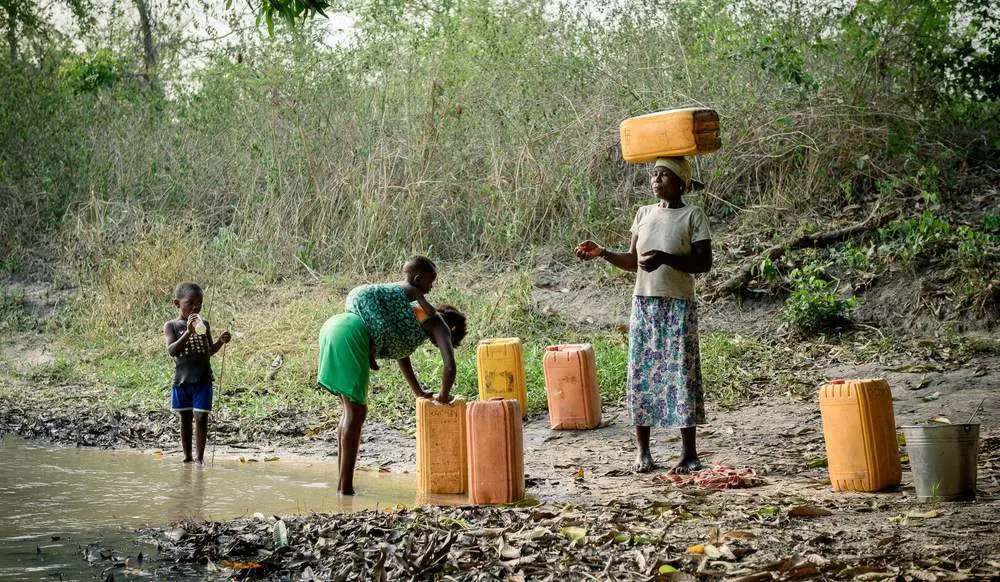
In the villages of the project region, water was not something that could be taken for granted for a long time. Many families walked one to three kilometres to open waterholes – for drinking, cooking, washing, and for everything else that everyday life requires.
A well doesn't simply change a water source. It can shorten distances, reduce hygienic risks and bring reliable water to where families, schools and community facilities depend on it.
Companies can provide targeted support for the next coordinated step of the local water supply.
WHAT IT'S ABOUT
Water is not just a question of quantity. It is a question of time, health and reliability.
At the start of PROJECT TOGO, there was no water supply network in the surrounding villages and hardly any safe ways to access drinking water. Open water holes filled up during the rainy season. Humans and animals used the same sites. In the dry season, the water quality deteriorated significantly.
Fetching water daily took energy and many hours. For families, it was part of everyday life. For schools, production facilities and community institutions, this meant they lacked a reliable foundation.
A WELL DOES NOT BEGIN WITH THE PUMP.
Finding suitable drilling sites is not a given in the region. At the beginning, easily accessible hydrological studies were not available. Therefore, a locally known traditional method was initially used as well: a coconut dowser marked possible water sources and checked them multiple times from different directions.
This procedure is part of the history of wells. However, it is not scientific proof. Only drilling will show whether water is actually present. Its quality is then tested in the laboratory.
Water has been found at the locations selected so far.

THE WAY TO THE WATER IS PART OF THE TASK.
Especially the final stretch between the paved road and the village is demanding. Transporting the equipment can take a whole day and accounts for a significant portion of the costs.
The drilling itself also remains demanding. Individual boreholes reach up to about 120 metres deep into the ground. Only when water is found, the borehole is stabilised, and the quality has been tested, can a borehole become a reliable water source.


FROM A BOREHOLE COMES A SUPPLY.
It pumps the water into an elevated plastic tank that can hold several thousand litres.
From there, the water flows by gravity to standpipes, schools, production buildings or via smaller pipe networks into the respective village.
The specific design depends on the location and requirements. Depending on the design, flow rate and usage, experience from previous projects shows that a well can supply up to around 2,000 people.
A well is not finished when water comes out of the pipe. It is only valuable when the supply still works tomorrow.
OPERATION IS NO MINOR MATTER.
As a rule, the village development committee takes responsibility for maintenance, use and the reporting of technical problems.
In some villages, users pay a small amount in the cents range. This can be used to create a local reserve for minor repairs.
PROJECT TOGO continues to support the facilities even after they are handed over: with repeated inspections, water sampling, and laboratory testing in Lomé. The results vary depending on the location. In some cases, the water quality is very high. In other places, the water tastes slightly salty due to its mineral content, but according to the available analyses, it is safe to drink.
TRUST IS BUILT IN EVERYDAY LIFE.
It was clear, odourless and almost tasteless – very different from the water from the familiar pools.
The technical solution alone does not change a habit. Trust was built with daily use.
Today, the wells are part of everyday life in the villages. People know who is in charge, where faults can be reported, and what a difference a reliable supply makes for families, schools, and community facilities.
WHAT CUSTOMER ENGAGEMENT CAN ENABLE
01
Location and deep well
Exploration of a suitable site, drilling and professional construction of a deep well.
02
Transport of drilling equipment
Access and site transport of the drilling equipment.
03
Pump, tank and dispensing points
Pump, water tank, support structure, pipes, and taps.
04
On-site connection
Connection of a school, a community building or a production facility.
05
Operation and repairs
Laboratory analyses, maintenance, spare parts and repair reserve.
06
Responsibility in the village
Briefing of the village development committee and clear responsibilities for operations.
A contribution can enable the complete construction of a well or support a clearly defined part of it.
WHAT WE REPORT ON
The following can be documented, among other things:
Location and technical design
Depth and result of the drilling
villages and facilities supplied
estimated number of users
Results of water analyses
Operational interruptions, maintenance and repairs
Status of the local reserve
open challenges and next measures
CLEARLY CATEGORISED
It supports a specific project area of PROJECT TOGO in Togo.
It takes place outside of the company's own value chain and is documented separately from CO₂e balances. The contribution is not offset against a Product or Corporate Carbon Footprint and does not alter any calculated emissions.
Companies support the local water supply. What has been implemented and how the systems are operated is documented in a comprehensible manner.
INTERESTED IN PROJECT TOGO PLUS WATER?
Let's talk