
KNOWLEDGE & ORIENTATION
Good climate action
does not start with
a label.
But with clarity.
CO₂ data helps in understanding emissions and making better decisions. Here we explain how it is generated, what it means, and how companies can handle it objectively.
WHY WE SHARE KNOWLEDGE
Responsibility begins with understanding.
It begins with understanding where emissions originate, which data is reliable, and what options for action follow from this.
CO₂ data must become a natural basis for information – comprehensible, accessible, and with clearly defined boundaries.
A balance sheet is not a status. It is the starting point for making better decisions.
Your starting point
Which question would you like to answer right now?
You do not need to already know the suitable balance sheet or the correct performance. Start where there is currently uncertainty in your company.
01
Understanding emissions
CO₂e, Scopes, system boundaries and data quality explained in simple terms.
Read more
02
Resilient accounting
Select CCF, PCF and partial assessments suitable for the specific task.
Read more
03
Communicate objectively
Show what is actually occupied – without creating a larger footprint.
Read more
04
Contribute additionally
Understanding when and how voluntary project support can be useful.
Read more
05
Decide with confidence
EmpCo, indicators, climate terms and legal developments at a glance.
Read more
06
Find support
Start your task – even if the right path is not yet clear.
Let's talk
The new natureOffice information trail
CO₂ data should no longer be anything special. Instead, it should be a matter of course.
Companies should not wait to make CO₂ data visible only when it results in a seal or a major climate claim. Our label does not evaluate. It leads to the information on which a specific CO₂ statement is based.
01 · Registration number
Example illustration · not actual proof of product
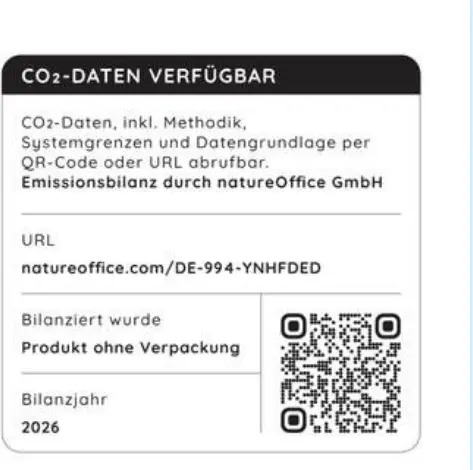
This factual note indicates that concrete CO₂ data is available for this company, product, or order.
02 · Access
Unique access
DE-994-YNHFOED
The QR code, web address or tracking ID lead to the uniquely assigned data record.
03 · Information
DE-994-YNHFOED
Balance sheet item · clearly identified
Result / reference year · clearly indicated
System boundary · documented
Methodology · comprehensible
Data status · versioned
What can become visible
One login. More than just a number.
What was considered? Company, product, service or order.
How was the calculation done? Methodology, system boundary, reference value and key assumptions.
Which data was used? Data status, sources, primary and secondary data.
What does the result mean? Classification, limitations and intended use.
The label does not provide the verdict. It leads to the information that allows people to make up their own minds.
Important for the application
The visible notice must in itself remain factual and clear. A QR code or a tracking page can provide additional information, but cannot subsequently correct an initial impression on a product or advertising material that is too far-reaching.
No prescribed procedure
What follows from CO₂ data remains a conscious decision.
Balancing, reducing, informing and supporting projects can belong together. However, they do not have to be combined into a fixed certification path.
01
Determine data
CCF, PCF or a clearly defined analysis establish a reliable basis.
02
Derive changes
The data helps to identify relevant emission sources and meaningful measures.
03
Inform objectively
Existing CO₂ data can be made accessible with system boundaries, reference years, and methodology.
Voluntary
Support projects
Companies can additionally support climate, nature or social project work.
A climate contribution is not a ticket to communicate CO₂ data.
Basics directly on this page
Knowledge that helps in everyday life.
You will find the key fundamentals right here. Not as a textbook or a product catalogue, but structured around the actual questions that companies need to answer.
01
Understanding CO₂
A figure is only as meaningful as its basis.
Carbon footprints translate the climate impact of different greenhouse gases into a common unit: carbon dioxide equivalents, or CO₂e for short. However, the result always depends on what was looked at and how the calculations were made.
CO₂e
Common unit of measurement for the climate impact of different greenhouse gases.
System boundary
Specifies which processes, sites or lifecycle phases are included.
Primary data
Originate directly from the company or process under consideration.
Secondary data
For example, they come from recognised databases, studies or models.
A CO₂ value is not made robust by many decimal places, but by a transparent calculation basis.
Why can two calculations differ?
System boundaries, data sources, allocations, emission factors and reference periods can differ. A difference therefore does not automatically mean that a calculation is incorrect.
Can two CO₂ values be directly compared?
Only if the reference value, system boundary, time period and calculation bases are sufficiently consistent. The pure numerical value is not sufficient for a reliable comparison.
What does data quality mean?
Among other things, it describes how specific, up-to-date, complete and comprehensible the information used is. Even robust calculations can contain estimates – the key is that this remains visible.
02
Calculate CO₂ footprint
The right balance sheet begins with a clear question.
Before data is collected, it should be clear which decision the calculation is intended to support. Not every task requires the same system boundary or depth of data.
CCF
Corporate Carbon Footprint
Considers the emissions of a company or organisation within a defined reporting period.
PCF
Product Carbon Footprint
Examines a product, a service or a defined process along a clearly specified system boundary.
Part
Isolated view
Can be useful if the question only concerns a clearly defined phase of the life cycle.
The better starting question
Not “What can we calculate?”, but “What do we want to be able to make better decisions on afterwards?”
03
Communicating CO₂
Good communication does not begin with the strongest statement.
It begins with reliable information. Before making a climate claim, a company should be able to answer three questions.
01
What exactly is being claimed?
Does it concern a company, product, location, time period or a single measure?
02
What is the statement based on?
Which calculation, system boundary, methodology, and data basis have been used?
03
Is it possible to view the basis?
Is the information understandable, easily accessible, and sufficiently up to date?
Probably not
"Our product is climate-friendly."
More comprehensible
A Product Carbon Footprint is available for this product. System boundary, reference year, methodology and data basis can be viewed via the specified access.
Transparency does not mean saying everything. It means saying precisely enough what can actually be proven.
04
Climate projects & voluntary contributions
Additional responsibility cannot be mandated.
Recording and reducing one's own emissions remains a task within the value chain. Furthermore, companies can voluntarily support climate, nature, or social projects. To do this, they need neither a climate status nor a certification system that makes the contribution a mandatory step.
We want companies to support projects because they want to enable their work – not because they would otherwise not be allowed to use a trademark.
Certificate-based
Acquire and decommission units
The project, standard, region, type and number of units, as well as the decommissioning, are documented. The quantity can be based on a balanced CO₂e amount; there is no offsetting against the CCF or PCF.
Direct support
Enable concrete project work
The project, measure, region, period and available evidence are documented. No CO₂e quantity is allocated to the company, product or contribution.
Precisely because the support remains voluntary, it can become visible what a company additionally chooses to do.
Neither of which means
The declared CCF or PCF will not decrease.
This does not make a company or product climate-neutral.
Our own reduction measures will not be replaced.
No general sustainability or climate status is created.
05
Law & Developments
Rules change. Responsibility for the statement remains.
With the EmpCo Directive and its implementation, the requirements for environmental and climate communication are changing. It is not just a single term that is decisive, but the overall impression created by the statement, symbols, design and context.
General environmental claims
Far-reaching statements require a correspondingly solid and accessible foundation.
Product-related compensation claims
Contributions outside the value chain must not create the impression that they alter the product characteristics or the PCF.
Private sustainability labels
For marks of an evaluative or award-winning character, special requirements apply.
Forward-looking statements
Claims about future environmental performance require clear, objective, publicly accessible, and verifiable commitments. They must be set out in a detailed and realistic implementation plan and regularly verified by an independent expert. The results must be accessible.
Must CO₂ data be certified from September 2026?
Not every specific piece of CO₂ information is automatically subject to a certification requirement. Special requirements apply to private sustainability labels. The specific communication and its overall impression remain decisive.
Is the natureOffice label a sustainability seal?
No. It is designed as a factual information notice. However, whether the specific use is classified accordingly always depends on the wording, design, placement and context.
Does this mean communication is automatically 'EmpCo-compliant'?
No. There is no officially awarded 'EmpCo-compliant' status. Whether the legal requirements are met must be assessed based on the specific use and its overall impression.
Can a climate contribution appear in the tracking?
Yes. It is presented as an additional action of the company and is clearly separated from the CCF or PCF. The contribution does not reduce the reported carbon footprint value.
Our content is intended for professional guidance. It does not replace a legal review of any specific individual case.
From information to application
What a company should be able to demonstrate in concrete terms.
Occasion
Useful information
Further basis
Website
Clearly state the subject, reference year, and result
Methodology, system boundary and data basis
Product or packaging
Point out existing CO₂ data
QR code or URL for the uniquely assigned record
Quote or Order
Indicate calculation scope and reference value
Key factsheet or tracking ID
Project support
State the project, type of contribution and period
Decommissioning certificate or project documentation
Knowledge for practical work
Some questions need a short answer. Others a resilient foundation.
Our documents help to correctly apply calculations, indicators and communication in everyday life.
Application Guide · CO₂ Data
Meaning, variants, placement, and correct application of the number plate.
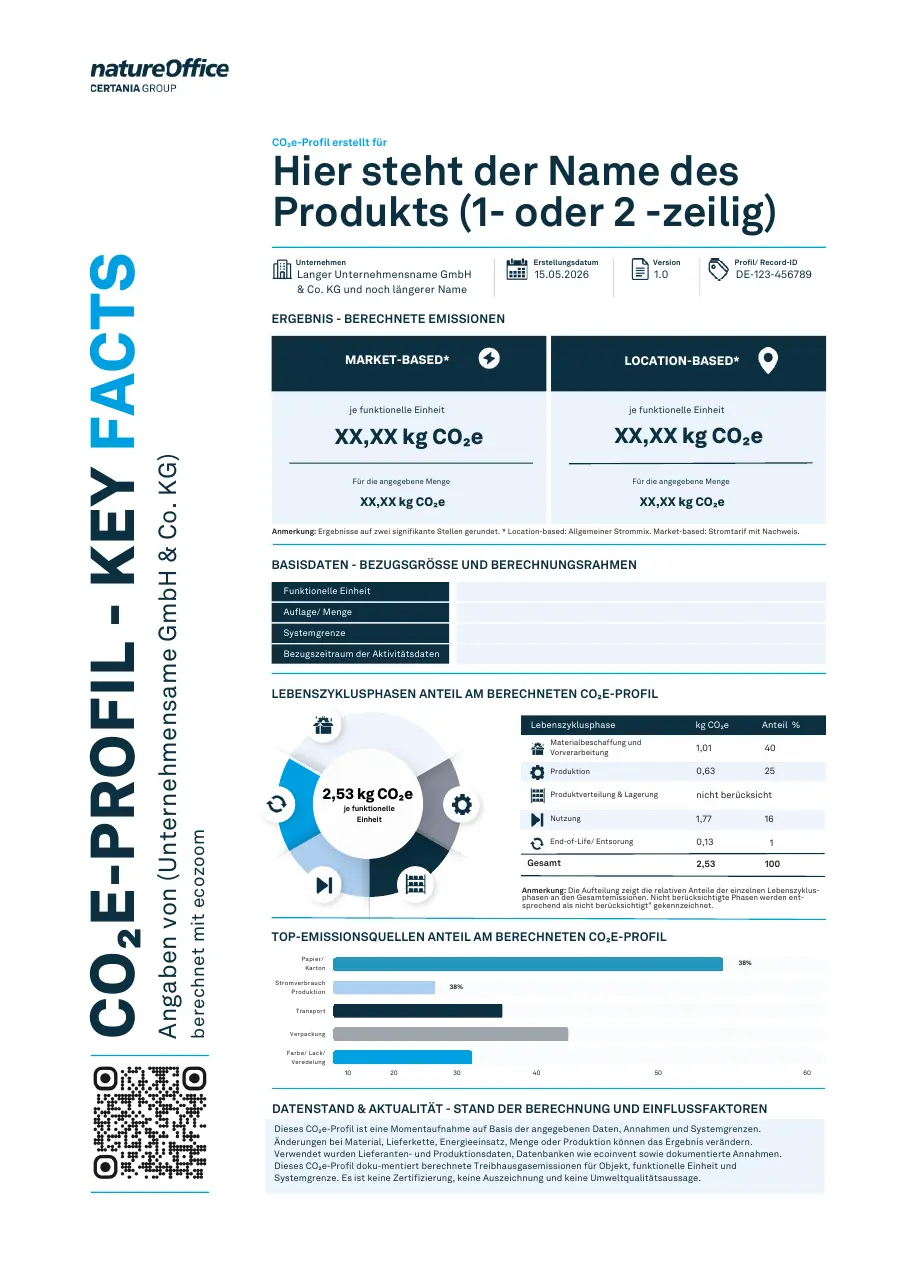
Example
CO₂ key factsheet
Result, system boundary, data basis, and methodology compactly documented.
Fact check
Climate communication from 2026
The most important questions about EmpCo, information, and private sustainability labels.
Methodology
How our CO₂ data is generated
Rules, assumptions and quality assurance for CCF, PCF and ecozoom.
Wording
Say what can be proven
Examples of website, offer, product information, and project support.
Knowledge keeps moving
Read, listen or discuss together.
New rules, better data, and experiences from practical work are developing the subject area further.
FAQs
What businesses particularly often want to know.
Will climate communication need to be certified in future?
Not every factual piece of information about CO₂ data automatically requires a seal. The decisive factor is what statement is being made, how it is presented, and what overall impression it conveys.
Is a climate contribution a prerequisite for showing CO₂ data?
No. Existing CO₂ data can be made accessible in a factual and comprehensible manner without simultaneously supporting a climate project. A voluntary contribution is documented as an independent decision.
Can climate projects continue to be supported?
Yes. Crucially, how the support is presented is key. It should be documented in a transparent manner and clearly separated from one's own carbon footprint.
How up-to-date should a CO₂ value be?
This depends on the intended use and on significant changes to the company, product or data set. The reference year and data status should always be identifiable.
Which is better: CCF or PCF?
That depends on the question. A CCF looks at the organisation, a PCF at a product or service. Often, both perspectives complement each other.
What if complete data is not yet available?
Data gaps can be closed by assumptions or secondary data, provided that their origin and significance are documented in a comprehensible manner.
I require assistance
You do not need to know which service you require yet.
Perhaps you would like to draw up a balance sheet, answer a customer query, review your previous climate communication, or find a meaningful way to deal with climate projects.
Let's not start with our offer. Let's start with your question.