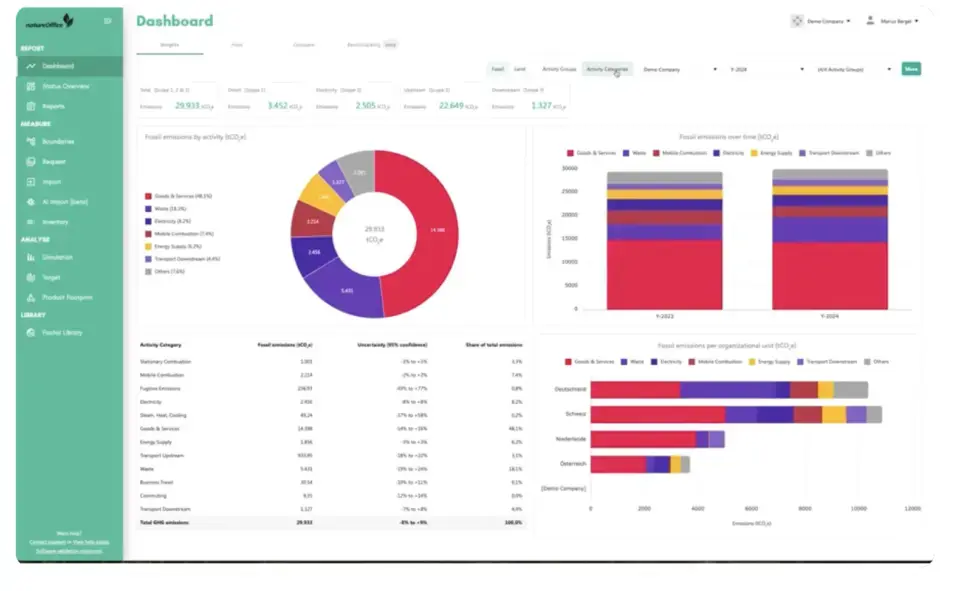
CCF SOFTWARE FOR ENTERPRISES
You do not simply need a CO₂ figure.
You need a foundation that you can continue to work with. ecozoom brings your emission data into a clear structure – natureOffice helps you to set up the process in a professionally sensible way.
THE RESULT IS ONLY THE BEGINNING
It is not about the most beautiful pie chart.
A Corporate Carbon Footprint creates a common foundation for everyone working with CO₂e data in the company: management, sustainability, purchasing, controlling, locations, and reporting.
It shows where emissions are generated, which data is already well-documented, and where there are still assumptions or gaps. This allows priorities to be better justified, developments to be compared, and new requirements to be addressed without having to start from scratch every time.
A CCF does not automatically make a company climate-friendly. But it does make decisions less blind.
01
Answer enquiries
CO₂e data is readily organised when customers, management, or business partners ask for it.
02
Identify priorities
Significant emission sources become visible and can be examined in a more targeted manner.
03
Understanding development
Financial years can be compared and changes can be attributed to their causes.
04
Continue working
The created structure remains usable for subsequent years, reporting and reduction planning.
Corporate Carbon Footprint
A balance sheet for your business. With a clearly defined framework.
A CCF captures a company's greenhouse gas emissions within defined organisational and reporting boundaries. This includes direct emissions, purchased energy and – depending on the accounting framework – relevant upstream and downstream activities.
A CO₂e footprint is information. Not an environmental judgement.
It is neither a seal of quality nor automatically a certification, verification, or statement about the environmental quality of the company and its products.
01
Clearly define the organisation
Companies, locations and the scope of consideration are defined in a comprehensible manner.
02
Classify financial year
The data status, base year, and update remain linked to the result.
03
Capture emissions in a structured manner
Scope 1, Scope 2 and relevant Scope 3 categories are visibly merged.
FROM MANY SOURCES TO A COMMON BASIS
The first assessment organises your emissions. ecozoom organises the process behind it.
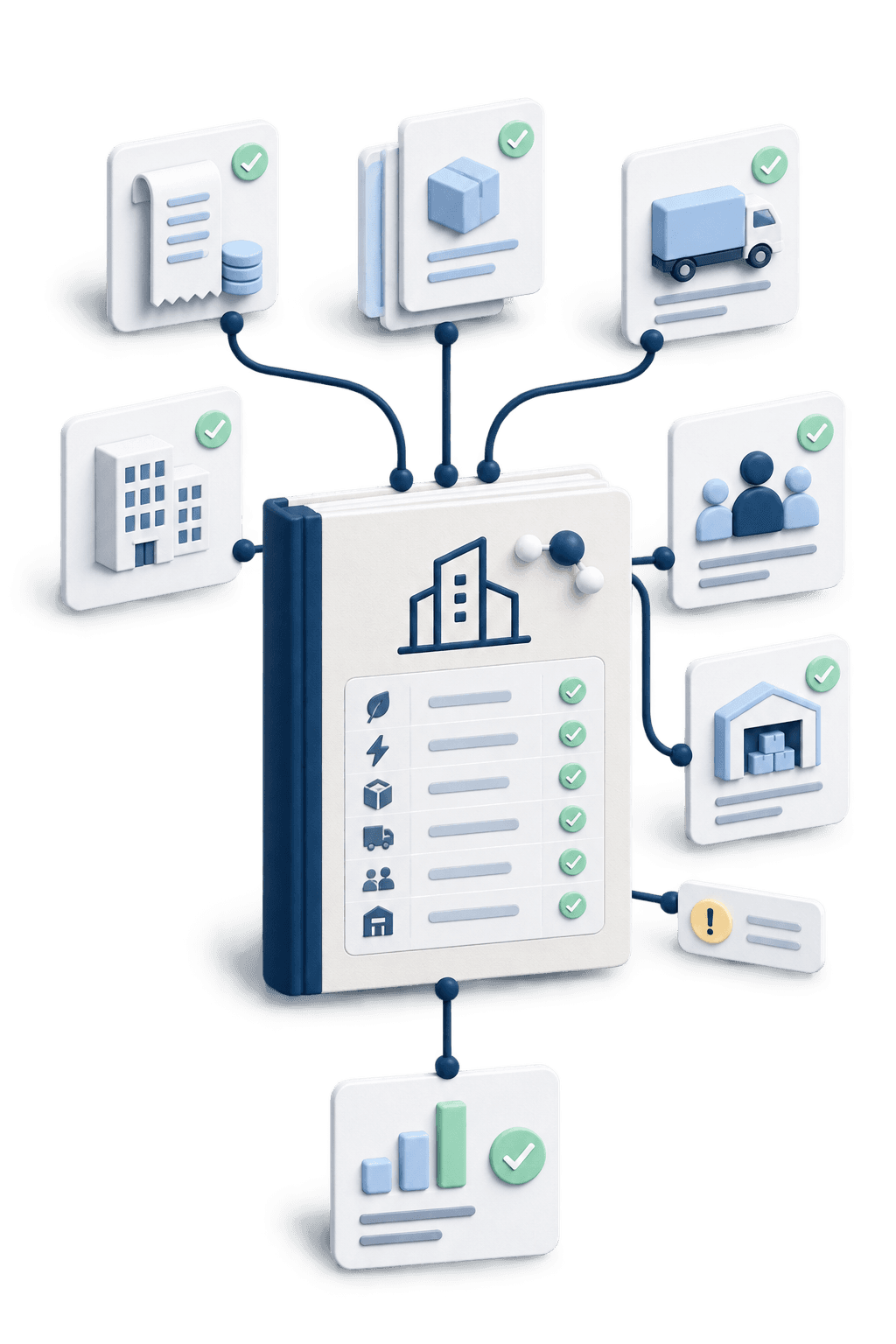
Data is rarely located in one place. It comes from purchasing, accounting, fleet management, building management, HR, logistics or individual companies.
Excel isn't the problem. Five Excel files with seven versions is.
01
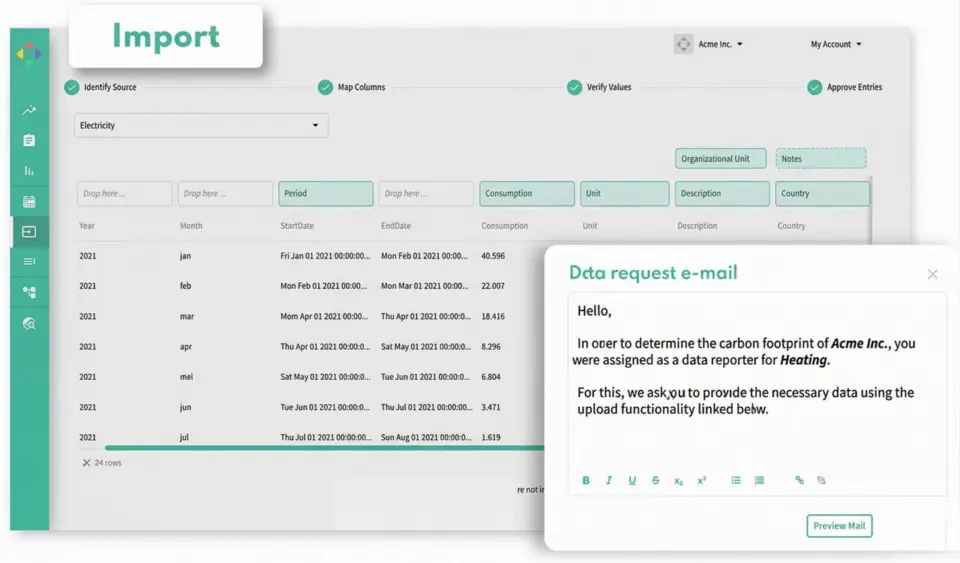
Enter data manually or import via file
02
Deposit sources, data statuses and assumptions
03
Organise responsibilities and access rights
04
Identify overdue dates and next tasks
SOFTWARE AND PROFESSIONAL SUPPORT
Software can calculate. But it cannot guess your organisation.
Which companies belong on the balance sheet? Which Scope 3 categories are relevant? What data quality can be achieved? This is precisely where ecozoom and natureOffice complement each other.
ECOZOOM
Holds the process together.
Data collection and imports · Calculation and documentation · Roles and status overviews · Dashboards and evaluations · Updating in subsequent years
NATUREOFFICE
Helps in structuring things sensibly.
Clarify organisational and reporting boundaries · Determine relevant emission sources · Manage data gaps and estimations · Professionally select emission factors · Verify plausibility of results and explain
The software holds the process together. We help you to structure it in a meaningful way.

FROM DATA POINT TO THE BASIS FOR DECISIONS
Set it up properly once. Then continue systematically.
01
Define the framework - determine companies, locations, balance sheet year and organisational boundaries.
02
Establishing data paths · Assigning responsible parties, data sources and required evidence within the company.
03
Collect data · Gradually merge Scope 1, Scope 2 and relevant Scope 3 activities.
04
Calculate and understand · Assign factors, check the plausibility of results, and look at key drivers.
05
Continue working · Use evaluations, document new data statuses and roll forward subsequent years.

YOUR CO₂ ACCOUNT
Your CO₂ account. Ready for your decisions.
We will set up your account so that you can work with your data – clear, comprehensible, and without having to start with an empty system.
01
Fully configured financial statement version
Organisational areas, reporting period, relevant emission sources, and consolidation boundaries are established from the very beginning.
Collect and provide data
You enter your data yourself, upload it in bulk, or answer specific data requests.
Central Overview
Activities, emissions, sources and evidence are all in one place.
Multiple users
Colleagues or external parties receive exactly the access they need for their task.
Secure Access
Role permissions, Single Sign-on, and multi-factor authentication protect your data.
02
Balance & Traceability
Carbon footprint for your company
You will receive a structured balance sheet covering Scope 1, Scope 2, and Scope 3.
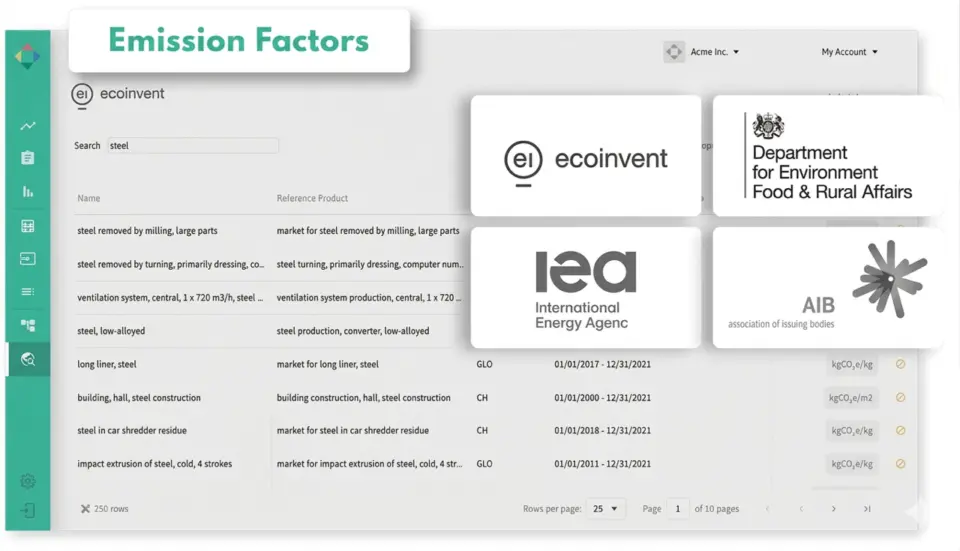
Traceable emission factors
The calculation is based on stored data sources and factors that we select for your use case.
Documentation and history
Balance boundaries, data sources, attachments and reports remain documentedly traceable.
Product Carbon Footprints
Where relevant, emissions can be allocated to product types and life cycle stages.
Consider climate risks
Assess initial physical and transition climate risks for locations or business units.
03
Decide & Further Develop
Evaluations and Dashboards
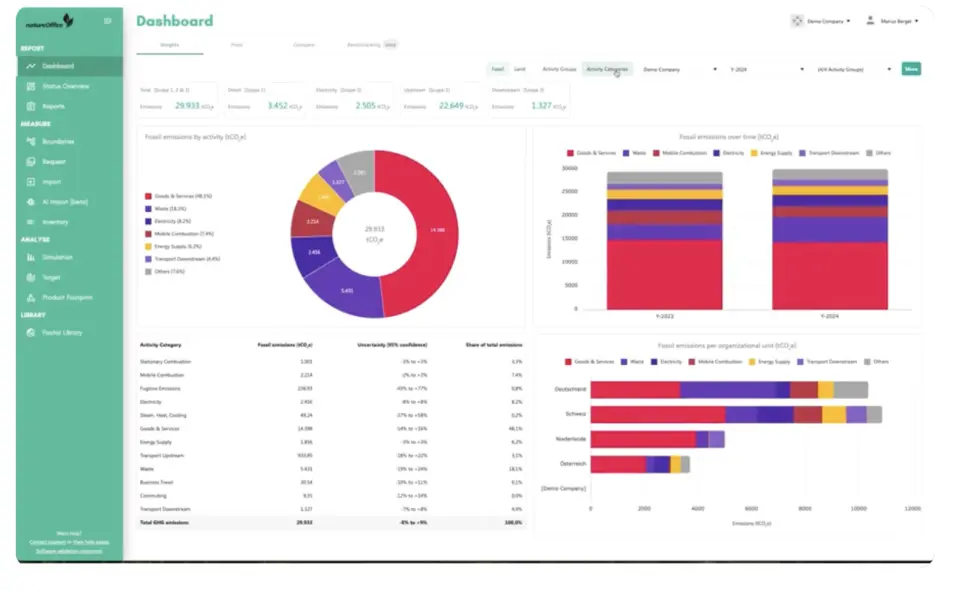
See where emissions are generated – by area, time period or emission source.
Reports and data exports
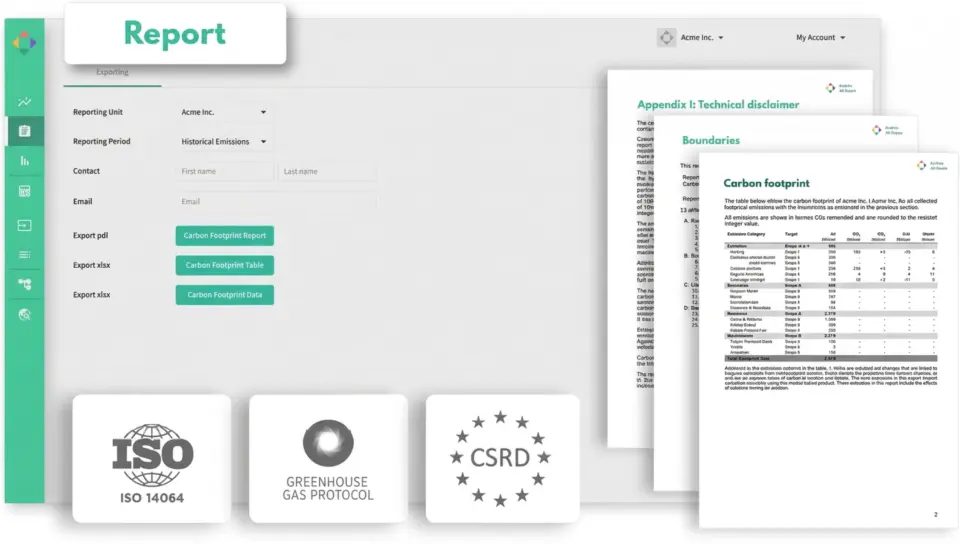
Create reports and exports for internal decisions, client requests, or your further reporting.
Set goals
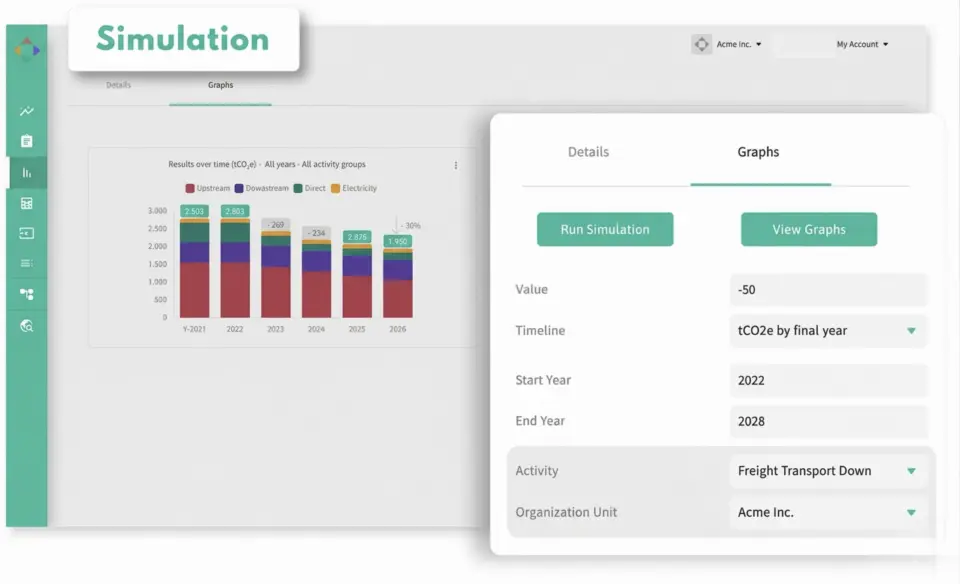
Define reduction targets and make it visible what development is required to achieve them.
Run through measures
See how changes in energy, mobility, or procurement can affect your emissions.
Industry comparison
Compare your emission data with anonymised companies from a comparable industry.
SCOPE AS REQUIRED
Which functions are activated in your account depends on your needs and the agreed scope of services.

KNOWING WHAT A NUMBER IS BASED ON
Not every piece of information is of the same quality.
Especially in Scope 3, estimates, average values and secondary factors cannot always be avoided. The crucial point is that their origin and use remain recognisable.
ecozoom documents sources, factors, assumptions and data gaps. Own or supplier-specific values can be taken into account if corresponding data is available. This also makes it clear where the database can be improved in the next accounting round.
STRUCTURED ACCORDING TO CLEAR RULES
Methodologically compatible. Without shortcuts in the small print.
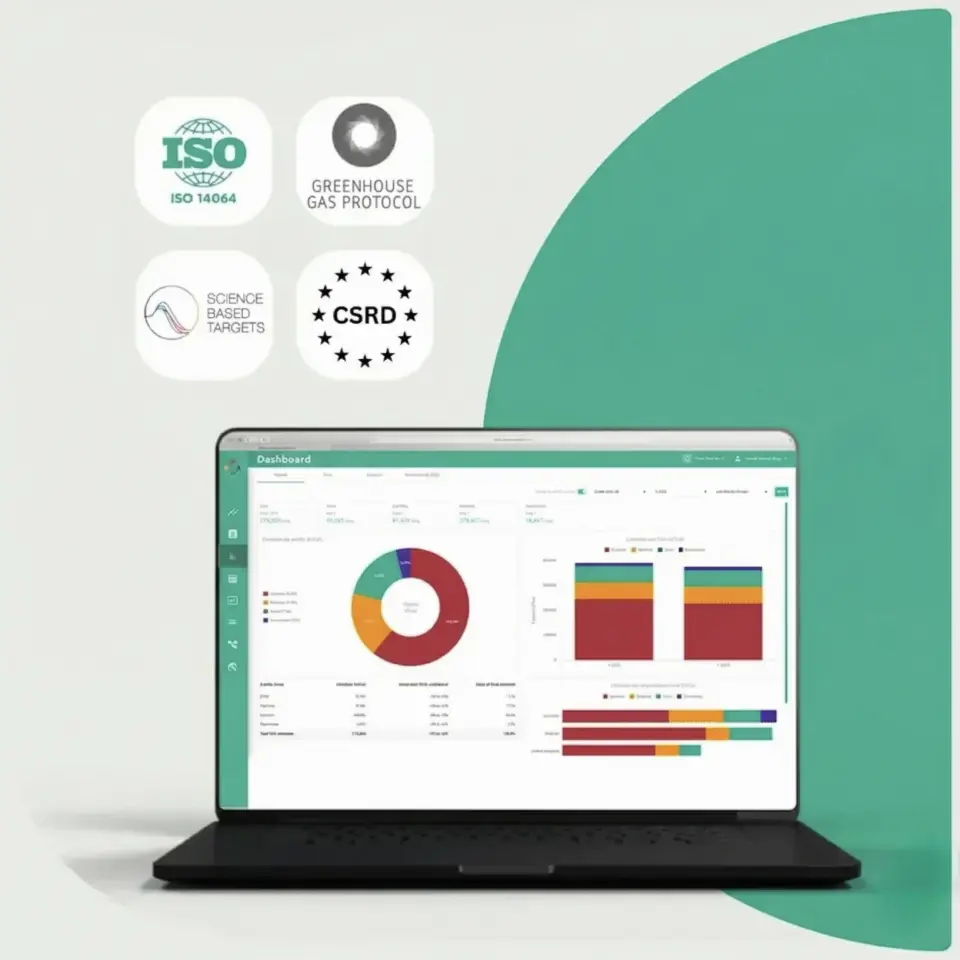
A Corporate Carbon Footprint can be structured in accordance with the GHG Protocol. Requirements of ISO 14064-1 can be taken into account and CO₂e data can be prepared for reporting requirements such as ESRS E1.
01
Organisational and reporting boundaries
02
Financial year and base year
03
Scope 1, Scope 2 and Scope 3
04
Data sources and emission factors
05
Assumptions, Estimates and Data Gaps
06
Changes and calculation statuses
Software alone is neither an audit nor a certification.
Whether a balance sheet meets a specific reporting or audit requirement also depends on the system boundary, data quality, evidence, and the chosen audit process. ecozoom ensures that the principles used can be documented in a traceable manner.
WHAT IS AVAILABLE AFTERWARDS
More than a number for the past year.
You will receive a data basis that can be maintained internally and explained to third parties.
01
A documented CCF with a defined organisational boundary
02
An overview of key emission sources
03
Deposited sources, assumptions, and emission factors
04
Identifiable data gaps and opportunities for improvement
05
Evaluations for decisions, enquiries and reports
06
A process that can be continued in the next financial year
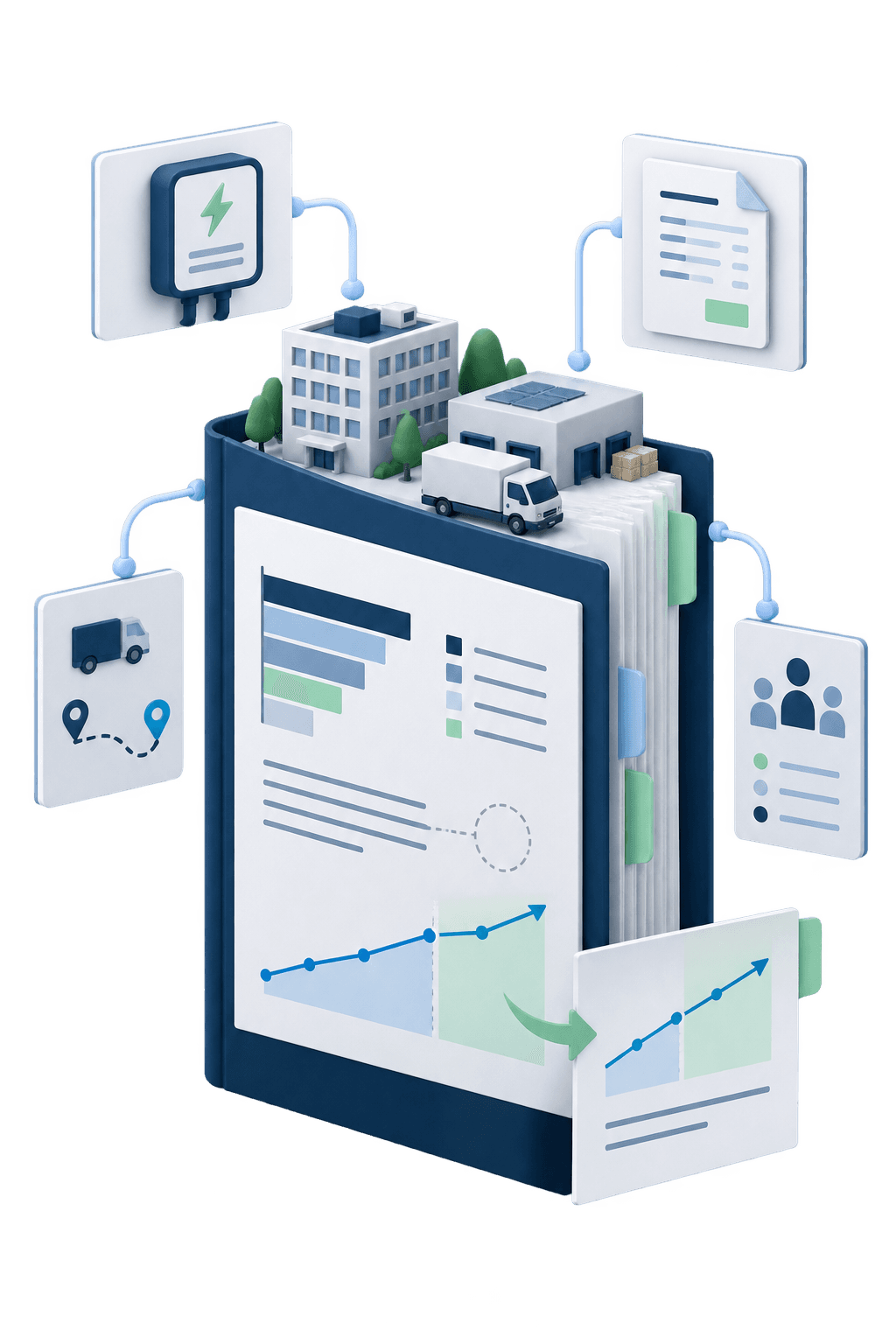
YOU DON'T NEED TO BECOME A CO₂ EXPERT FIRST
Getting started begins with your business. Not with a blank input mask.
01
Clarify the initial situation
Review organisation, locations, requirements and existing data.
02
Set up structure
Map accounting boundaries, roles, and data scopes in ecozoom.
03
Collect data
Work independently, together with us, or in a suitable combination.
04
Understanding the result
Consider drivers, limitations, and open data points together.
05
Carry forward balance
Maintain the structure for subsequent years, reports and further decisions.
What could your CCF process look like?
FREQUENTLY ASKED QUESTIONS
CCF software, briefly explained.
The key questions on corporate carbon footprint software, data, frameworks and updates.
What is a Corporate Carbon Footprint?
A Corporate Carbon Footprint is a company's greenhouse gas balance sheet within defined organisational and reporting boundaries. The result is reported in CO₂ equivalents and assigned to a defined assessment year.
Which data is required for a CCF?
Typical data concerns fuels, the vehicle fleet, purchased energy as well as relevant upstream and downstream activities – such as goods, services, transport, business travel or waste. The specific scope is defined for the footprint.
Does all the data already have to be fully available?
No. The carbon footprint can be built up step by step. However, missing data, assumptions used and estimates should be transparently documented and targeted for improvement in future reporting years.
Is the calculation in ecozoom checked automatically?
No. ecozoom supports calculation and documentation, but does not replace independent auditing, verification or certification. Such an audit can be arranged separately if required.
Can the balance sheet be carried forward into the next year?
Yes. That is precisely one of the key benefits of the software: organisational structure, data flows, sources, and calculation bases are preserved and can be updated with a new dataset.
THE NEXT STEP
A good CO₂e balance doesn't just answer one question. It makes the next ones easier.
Let us look at what data basis you need today, what is already in place, and how this can be turned into a process that suits your company.