PROJECT PROFILE · CERTIFICATE-BASED CLIMATE PROTECTION
VCS2736 describes an LDAR project in a natural gas distribution network spanning approximately 4,000 kilometres. This page separates leak detection, measurement, repair, methodical emission calculation, registry pathways and the specific allocation of units.
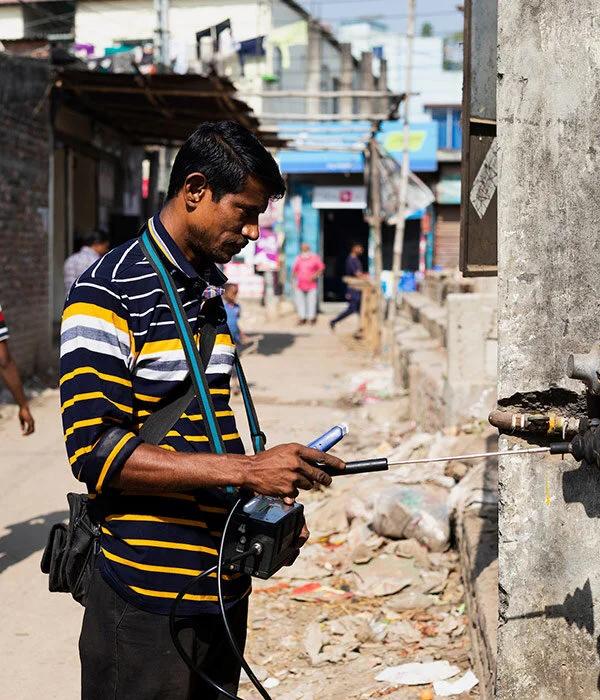
Bangladesh · Stock photo
Note: The image is solely for geographical classification. It does not show the BGDCL gas network, project facilities, or project work, and does not demonstrate any impact. Photo: Sarowar Hussain · Pexels.
COUNTRY
Bangladesh
Verra ID
VCS2736
PROJECT APPROACH
LDAR · Methane
ARTICLE 6.4
PA10559 · Registered
WHY THE MEASURING CHAIN MATTERS
The leak is detectable. The avoided emission is quantified.
A measuring device records gas flow or gas concentration. It does not automatically measure avoided tonnes of CO₂e.
For the project balance sheet, leak rates before and after repair, the assumed duration of the reference loss, gas composition, and other methodological parameters are linked together. Only from this is a calculated emission reduction for a defined period generated.
CONTENT
01 · Project profile
01 · PROJECT AT A GLANCE
The data pass for VCS2736 and PA10559
The delivered project documentation details the technical approach and a completed monitoring period. Today's mechanism status is reported separately.
Reducing Gas Leakages within the Bakhrabad Gas Distribution Network in Bangladesh
LOCATION
BGDCL network in Comilla, Brahmanbaria, Chandpur, Lakshmipur, Noakhali and Feni · Bangladesh
NETWORK COVERAGE
around 4,000 km · project specification
PROJECT PARTICIPANTS
EcoGas Asia Limited
GRID OPERATOR
Bakhrabad Gas Distribution Company Limited (BGDCL)
PROJECT APPROACH
Leak Detection and Repair (LDAR) on above-ground components of a natural gas distribution network
TECHNICAL MEANS
including Hi-Flow Sampler, Gasurveyor, leak database, GPS and photo documentation
Verra ID
VCS2736
HISTORICAL CDM REFERENCE
CDM 10559
ARTICLE 6.4 REFERENCE
PA10559 · listed as "Registered" since 26/06/2025
ARTICLE 6.4 CREDITING PERIOD
01/01/2021–31/12/2025 · ended on the test date
METHODOLOGY
AM0023, Version 04.0.0 · Leakage reduction from natural gas pipeline compressor or gate stations
SECTORAL SCOPE
10 · Fugitive emissions from fuels
PROJECT START / BASELINE SURVEY
28/01/2019 · Submission of project documents
DOCUMENTED MONITORING PERIOD
01/01/2022–31/12/2022
VERIFIED EMISSION REDUCTION
1,479,035 t CO₂e for 2022
EX-ANTE VALUE FOR 2022
1,520,824 t CO₂e · planned value; verified result 2.75% below
CDM ANNUAL FORECAST
2,441,426 t CO₂e per year · ex-ante, no verified annual result
ARTICLE 6 AUTHORISATION / CORRESPONDING ADJUSTMENT
cannot be automatically derived from PA10559 or VCS2736; check separately for the specific unit
CCP STATUS
to be proven separately for a specific unit offered and its vintage
TEST BENCH OF THIS PAGE
5 September 2026
Three identifiers, no synonyms: VCS2736, CDM 10559, and PA10559 refer to different registry or mechanism references for the same project activity. They must not be used interchangeably for unit type, issuance, and retirement. The activity was transitioned to the Paris Agreement Crediting Mechanism in 2025; this does not automatically convert previously issued VCUs into Article 6.4 units, nor does it automatically trigger a Corresponding Adjustment. The status "Registered" does not represent an ongoing crediting period. The complete registry documentation is authoritative for additionality.
02 · WHAT THE PROJECT PROVIDES FOR
Systematically find, quantify and repair leaks
The project addresses fugitive methane emissions from above-ground components of the existing gas network. Crediting is based not only on the number of repaired components, but on the documented leak rate within the methodological project boundary.
01
Examine network components
Valves, flanges, regulators, insulating pieces and other accessible components are systematically checked for leaks. Emergency repairs and certain measures already planned are to be treated methodologically separately.
02
Quantify leak rate
Measuring devices record relevant gas flows or concentrations. The measuring point, device, calibration, time, and component are documented in a data chain.
03
Repair and measure
Detected leaks are repaired and checked again. A database, GPS data, photos, and quality controls are intended to ensure the traceability of the measure.
03 · HOW A UNIT IS CREATED
AM0023 forms the methodological framework mentioned in the documentation. The exact calculation depends on measured values, gas composition, time assumptions and the version of the methodology applied.
01
Set reference case
The baseline describes the gas loss without the additional systematic LDAR programme. The documentation mentions a previously primarily safety-driven, less comprehensive leak detection.
02
Measure leak rate before repair
For identified components, the gas flow is quantified using suitable equipment and assigned to the respective measurement data record.
03
Calculate repair effect
Leakage rate, assessable period, and methodological parameters are linked. Gas composition and the applicable global warming potential convert the methane volume into CO₂e.
04
Check and register
Monitoring data and calculation are independently verified. Only then can units for a specific period be issued in the respective applicable registry or mechanism.
04 · OTHER PROJECT REFERENCES
What can be described in addition to the emission calculation
Grid losses, maintenance expertise and occupational safety can be project-related. They require their own indicators and do not automatically follow from an issued climate protection unit.
INFRASTRUCTURE
Less uncontrolled gas loss
Repaired leaks reduce the measured loss of the recorded components. This does not imply any statement about the entire gas network outside the project boundary.
MONITORING
Structured measurement and data processes
Training, calibration, leak database, GPS and photo documentation strengthen the technical traceability of the LDAR process.
OPERATION
Target maintenance more precisely
Measurement-based leak detection can highlight the need for repairs. However, a general improvement in security of supply or safety must be proven separately.
demarcation
Natural gas remains a fossil fuel
The reduction of fugitive methane emissions is no replacement for a fossil-free energy supply and does not make natural gas, the grid, or its use ‘clean’ or climate-neutral.
FOR COMMUNICATION
Potential additional benefits must not be derived across the board from the project category or SDG references. The decisive factor is which indicator was actually collected and verified in which period.
05 · FOR SUPPORTING COMPANIES
A project identifier is not yet a unique assignment.
A reliable allocation includes at least:
01
Project name and applicable identifier
02
Standard or mechanism and unit type
03
specific quantity in t CO₂e
04
Vintage and monitoring period
05
Issuance and decommissioning reference
06
complete serial number range
07
Beneficiary and documented purpose of use
08
if applicable, proof of authorisation or corresponding adjustment
06 · CLASSIFICATION AND COMMUNICATION
What the support means – and what it doesn't
A voluntary climate contribution is presented separately from reductions within one's own value chain.
CAN BE DOCUMENTED
is not automatically assigned
an LDAR project in an existing natural gas distribution network
renewable energy, a fossil-free system or “clean gas”
1,479,035 t CO₂e verified emission reduction for 2022
the same reduction in subsequent years or a permanent annual payment
VCS2736, CDM 10559 and the registered activity PA10559
the automatic equivalence or transfer of the respective units
an Article 6.4 registration of the activity
a corresponding adjustment for each VCU or each unit offered
the reduction of quantified fugitive methane emissions
Climate neutrality of the gas grid, natural gas or a company
the decommissioning of a specifically designated unit for a beneficiary
a reduction in one's own emissions or a green product label
07 · SOURCES AND RELEVANCE
The register paths openly accessible
Status, crediting periods and available units may change. For a specific allocation, the respective register details at the time of retirement are decisive.
PROJECT REGISTER
Verra Registry
VCS2736 · Project data, documents and units
Paris Agreement Crediting Mechanism
Article 6.4 · PA10559
Status, registration date and crediting period
HISTORICAL REFERENCE
UNFCCC CDM · 10559
Project participants, methodology and ex-ante estimation
NATUREOFFICE
General rules for voluntary climate contributions
TEST BENCH
5 September 2026
We are happy to answer any specific questions about the unit, its vintage, mechanism or register path on a factual basis.